Total: $0
Baby can't wait?
(exclusive offer)

It's three in the morning, your baby has been crying for two hours straight, their tummy is tense, and their face is red from straining. You've tried everything - changing feeding positions, massaging them, warming their diapers. But nothing helps. And that's when you start to wonder: could it be the formula problem?
More and more parents are turning to goat milk baby formula as an alternative to traditional cow's milk formulas. And it's not just a fad - there are real stories behind it from families who spent months looking for a solution for their children. Many moms and dads ask, "Is goat milk formula better?" - especially when it comes to sensitive children with constant colic or spitting up.
We wrote this guide to help you understand all the nuances. Here you will find information on the benefits of goat milk formula, the options available, and why organic formulas are becoming the choice of more and more families. We want you to feel confident that you are choosing the best goat's milk formula for your infant.
Remember that feeling of helplessness when you look at your child and don't know how to help? Most parents have been there. And we know for sure that switching to the right formula can change everything - both your life and your baby's.
So, what is the secret of goat milk formula benefits? There are several scientifically proven reasons why goat milk is better:
The fat globules are smaller. Imagine that your child's digestive system has to process a large stone or a handful of small pebbles. Which is easier? In goat milk, the fat is in the form of small pebbles that are much easier for a baby's body to break down.
A different protein structure. Cow's milk contains a lot of alpha-S1 casein, the very protein that causes digestive problems in many children. Goat's milk contains significantly less of it, but more beta-casein, which is much gentler on the stomach.
Natural prebiotics. Goat milk contains oligosaccharides, substances that help beneficial microflora develop in the intestines. It's like creating a comfortable environment for the "good" bacteria that protect your baby's tummy.
When we talk about goat milk infant formula, we're not just talking about replacing one product with another. It can be a solution for babies who:
Constantly suffer from gas and bloating
Are fussy after every feeding
Suffer from constipation
Have mild sensitivity to cow's milk protein (not to be confused with a true allergy - in which case, you definitely need to see a doctor!)
Why goat milk formula for sensitive stomachs works:
Less irritating to the mucous membrane. Goat milk has a softer texture that is less aggressive on the intestinal walls.
Digests faster. The faster the formula leaves the stomach, the less time there is for fermentation and gas formation.
Reduces colic and gas. Many parents note that within a week of switching to goat milk formula, their babies became calmer, pulled their legs up less often, and cried less.
Proven options that have helped thousands of families:
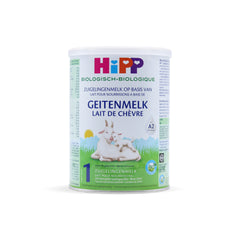
HiPP Dutch Goat Stage 1. Trusted European quality. Organic ingredients, a gentle formula without starch or sugar. Ideal for newborns from the first days of life.
Holle Goat Formula. This is a biodynamic organic formula from Switzerland. The goats graze on environmentally friendly pastures and are fed natural feed. This formula is designed for the most sensitive babies - without aggressive additives.
Kendamil Goat Formula is a British formula with whole goat's milk. The main difference is that they do not use palm oil, which often causes constipation in children. Instead, they use natural milk fats that are easily digestible.
It is important to understand that if a cow's milk protein allergy has been diagnosed, simply switching to a goat's milk formula may not solve the problem. In such cases, it is essential to consult a pediatrician!
But if it is a matter of sensitivity, intolerance, or simply that the usual formula "doesn't work," goat milk formula may be the solution you have been looking for.

Now, let's talk about organic goat milk baby formula. We live in a time when more and more parents are thinking about what exactly goes into their children's bodies. But what does "organic" formula mean? Let's break it down:
Goats are fed organic feed. No GMOs, minimal pesticides, and chemical fertilizers. The animals receive high-quality nutrition, which means that the milk is cleaner.
Strict production control. Organic formulas undergo additional testing and certification. This ensures that there are no unnecessary ingredients in the formula.
Clean sources of ingredients. From farm to packaging, the entire process is monitored for environmental safety.
Organic is not just a nice word on the packaging (especially in European formulas). For many families, it is a matter of values. We want to raise our children in harmony with nature and choose products that do not harm the planet. And if there is an opportunity to give your child a formula that is produced with care for the earth and animals, why not take advantage of it?
So we come to the main question: goat milk formula vs cow milk formula - which is better? Let's be honest: there is no universal answer. Every child is unique, and what is ideal for one baby may not be suitable for another. But let's compare the key points:
Digestion:
Goat milk formula is usually easier and faster to digest
Less risk of constipation and colic
But cow milk formula is also perfectly suitable for some babies
Nutrition:
Both formulas are adapted to the needs of infants
Contain all the necessary vitamins and minerals
Differences in absorption depend on the individual characteristics of the child
Tolerability:
Goat milk formula is often better tolerated by babies with sensitive tummies
But that doesn't mean it's automatically "better" for everyone
Price:
Goat milk formulas are usually more expensive
You need to weigh up your budget and the real benefits for your particular child
We don't want to mislead you: goat milk formula is not a magic solution to all problems. But for many families, it is a real lifesaver.
Our advice: Before changing formulas, be sure to talk to your pediatrician. Tell them about the symptoms that concern you. The doctor will help you understand whether switching to goat milk formula is really justified in your case, or if the problem lies elsewhere.
Remember: the best formula is the one that keeps your baby full, happy, and healthy. If you see that your child is growing well, their tummy doesn't hurt, they sleep peacefully, and they are happily discovering the world, then you have made the right choice.

By: Isa
Happy mom of 1. Built her career in the medical equipment industry, and later on converted her passion to serving babies. Organic Life Start customer service since 2022.



Kasey -
Goat milk formula wasn’t even on my radar until another parent mentioned it at daycare. I assumed it was basically all the same, but there are actually quite a few options once you start looking. The differences in ingredients and whey-to-casein ratios were what I paid the most attention to. I also learned that goat formula isn’t automatically the answer for every kind of stomach issue or milk allergy. There was definitely more to compare than I expected.
Alex -
This reminds me of when we switched to goat milk formula because our baby had frequent tummy discomfort. It wasn’t an instant change, but after a couple of weeks, feeding became much smoother for us.
Ryan -
I had the same problem until I found Hipp Dutch Goat. Thanks to Hipp, my baby is now doing great!