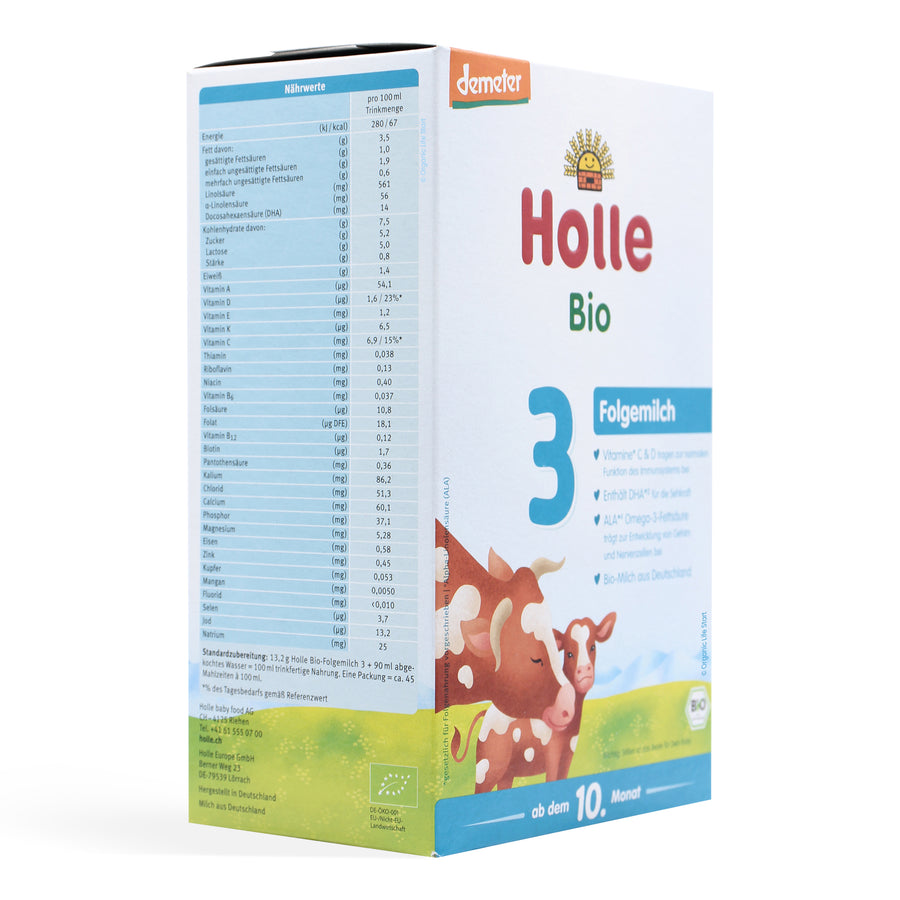
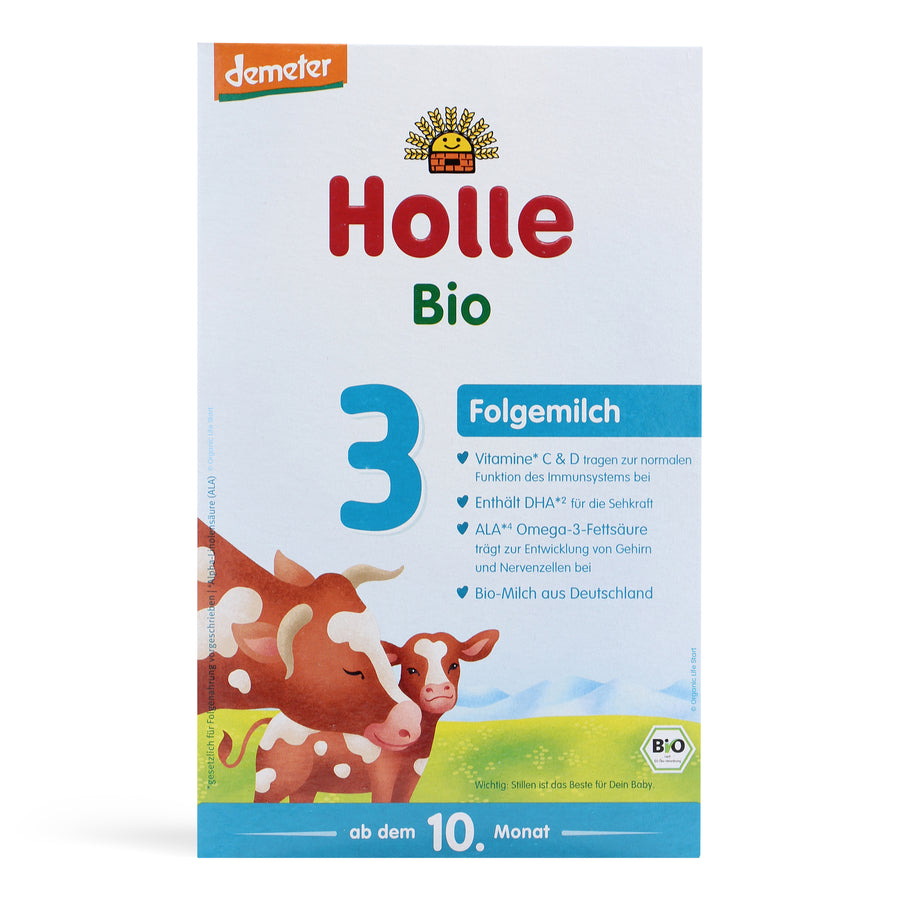
Holle Stage 3 Organic Formula
10+ Months • 600g box
Holle Stage 3 is a non-GMO, vegetarian, soy-free formula for toddlers aged 10+ months. Each 600g box offers essential vitamins and minerals they need. Sugar-free, chemical-free.

In The News : March 2025 Consumer Reports Safety Test
Safest Formula In All Categories In USA
Consumer Reports tested 41 formulas for lead, arsenic, BPA, acrylamide, and PFAS. Trusted by over 5 million in the USA. Holle Bio came out with a perfect score. Best of the Best 🏆
- 41 baby formulas tested
- Featured & highlighted for safety
- 130+ product testing experts

Image from Consumer Reports.
All Holle Bio formulas use the same high quality formula base. You can read the full report here.
All offers and discounts are valid exclusively for Holle formula.
One-Time Purchase: Enjoy free express air shipping on all one-time purchases of $190.00 or more.
All subscription plans can be edited, paused, or canceled at any time before your next order is processed. Please note that free express air shipping is a benefit of active subscriptions only — if a plan is paused or canceled, orders return to the standard $190.00 free shipping minimum shown above.
The Organic Life Start Difference
We want to empower all parents to make an informed decision about where they buy. Here's why over 70,000 parents have chosen to shop with us.
| Feature | Organic Life Start | Competitors |
|---|---|---|
| Typical Courier Pickup Time | <3 hours | ~48 hours |
| Average Shipping Time | 2-4 business days | 4-9 business days |
| Order Processing | 7 days/week | 5 days/week |
| Delivery Guarantee | Marked as "delivered" or reship free | None |
| Customer Service Response | <17 minutes average | ~36 hours average |
| Customer Service Staff | 100% are moms | 100% generic |
| Holle Stage 3 Organic Authenticity | Newest stock from Holle | Unknown product origins |
| Typical Expiration Dates | 10-13 months | Up to 6 months |
Over 3,985 5-star reviews
Fast shipping! Had this formula available when almost every other retailer was out.
Fast shipping! Had this formula available when almost every other retailer was out.
Great products, shipped fast, tariff free (covered by the seller). Couldn’t recommend enough! Melissa Kelley
Great products, shipped fast, tariff free (covered by the seller). Couldn’t recommend enough! Melissa Kelley
Detailed info about the formula was so helpful! Got it so fast!
It was easy to choose the formula based on the information on the website. I got the formula so fast and my baby loves it.
I was so excited to try this formula for my granddaughter, because she’s barely two months old and has already been dealing with eczema, gas, and significant stomach issues. I made a mistake when ordering and didn’t realize I selected a type that wasn’t suitable for her lactose intolerance. The company sent exactly what I ordered, so that wasn’t their mistake. But since they don’t offer refunds, I’m now trying to sell the six-pack I purchased so I can reorder the right formula. I chose this company because of their 5-star reviews and no unnecessary additives. I’m still hoping to try the correct formula soon and hopefully see a difference for my precious granddaughter.😊
I was so excited to try this formula for my granddaughter, because she’s barely two months old and has already been dealing with eczema, gas, and significant stomach issues. I made a mistake when ordering and didn’t realize I selected a type that wasn’t suitable for her lactose intolerance. The company sent exactly what I ordered, so that wasn’t their mistake. But since they don’t offer refunds, I’m now trying to sell the six-pack I purchased so I can reorder the right formula. I chose this company because of their 5-star reviews and no unnecessary additives. I’m still hoping to try the correct formula soon and hopefully see a difference for my precious granddaughter.😊
It was quick and easy to order. We got order either within a week or less.A friend referred me to the website and I am so thankful for it!!!!
It was quick and easy to order. We got order either within a week or less.A friend referred me to the website and I am so thankful for it!!!!
I needed the formula fast!
I just had a baby and I was having a hard time breast-feeding so I ordered goat milk formula from organic life start and I was so happy because it was shipped and I received it so quickly. Great packaging and quality formula. Very thankful I found this company!
Such fast shipping, I did my order on Wednesday and received my order on Friday morning. My baby loves his HIPPA Formula, I will continue to order his formula on this site.
Such fast shipping, I did my order on Wednesday and received my order on Friday morning. My baby loves his HIPPA Formula, I will continue to order his formula on this site.
The order shipped very very fast and I haven't had a happier baby. He loves the hipp ha 1 and I'm just glad we finally found a formula for him and at a great price. This is the best website to order formula from hands down.
The order shipped very very fast and I haven't had a happier baby. He loves the hipp ha 1 and I'm just glad we finally found a formula for him and at a great price. This is the best website to order formula from hands down.
Fast and great service my baby loves the formula it arrives in just three days which is so good
Fast and great service my baby loves the formula it arrives in just three days which is so good
Babyfood arrived quickly and the infant is doing well on the formula
Babyfood arrived quickly and the infant is doing well on the formula
Fast shipping and quality formula
Fast shipping and quality formula
Showing our 4 & 5 star reviews
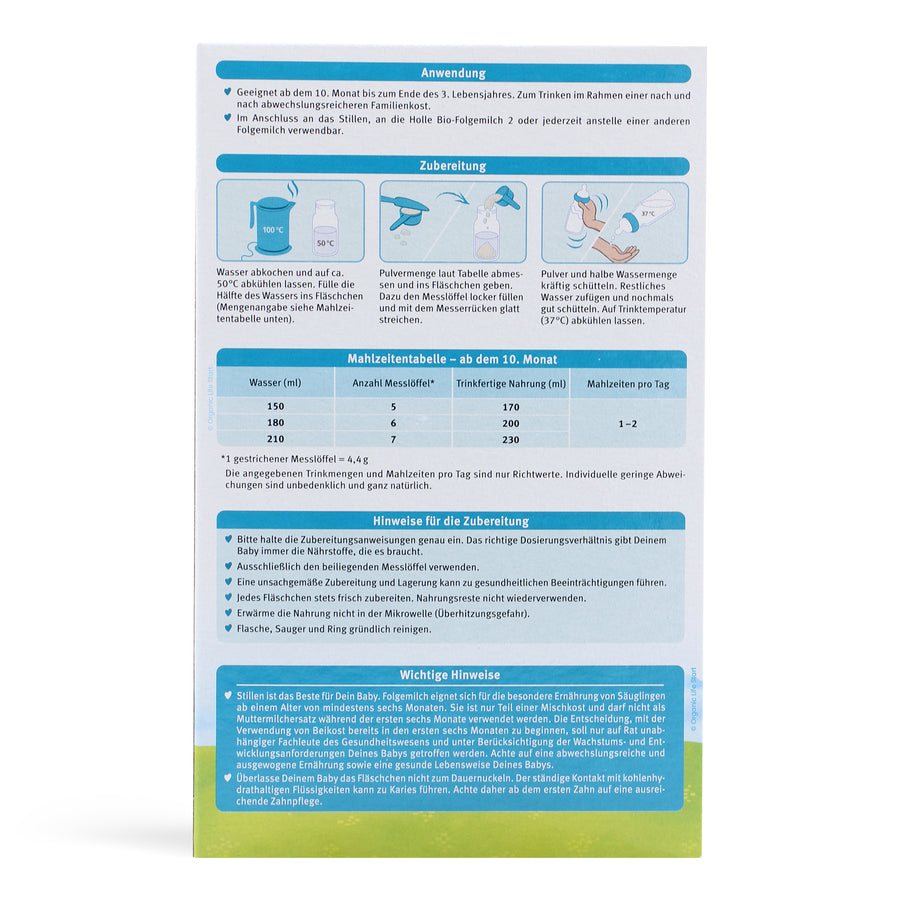
Holle Bio Stage 3 Formula Feeding Guide
| Age | Water | Scoops | Ready-Made Formula | Meals Per Day | Boxes Needed |
|---|---|---|---|---|---|
| 10+ m. | 150ml (5 oz) | 5 | 170ml (5.7 oz) | 1-2 | 2 per month |
| 180ml (6 oz) | 6 | 200ml (6.8 oz) | 2 per month | ||
| 210ml (7.1 oz) | 7 | 230ml (7.8 oz) | 2.5 per month |
w. = weeks · m. = months
Holle Bio Stage 3 Formula Calculator
Baby's age in months — by default we calculate using Holle's recommended feed quantity for your baby's age.
Recommended at
1 Package of Holle Bio Stage 3 Formula = about 136 scoops of formula. Holle Bio Stage 3 Formula Scoop Size = 4.4 grams of dry formula powder (0.155 ounces).
How much Holle Stage 3 Organic should you buy? The estimate for how many units of formula you'll need is based on an assumption that baby formula is the primary source of nutrition within your baby's diet, and takes into account Holle Stage 3 Organic packaging and scoop sizes, as well as the Holle's recommended dosage at each age. Unless stated per month, the calculation is a total for the entire age bracket. On average, a typical toddler uses 2 boxes of Holle Stage 3 Organic per month, when fed using Holle's feeding instructions. If you supplement with breast milk or other foods, your calculation may be different. Always follow your pediatricians advice for feeding instructions that are unique to your baby.
Holle Stage 3 Organic Expiration Date: Please note that Holle uses the European expiration date notation, which reads DD/MM/YYYY (day/month/year). This European date format is different to the MM/DD/YYYY format more commonly found in North America.
The manufacturer may change its packaging style at any moment without notice. Always follow the instructions found on your packaging, even if they differ to the above instructions. We are not able to ship a preferred packaging style since the manufacturer decides which style they will be making in a given batch.
An estimate from Holle's own feeding table, for planning your next order.
Perfect For
- 100% Organic Formula
- Yes
- Non GMO Formula
- Yes
- Sugar Free Formula
- Yes
- Corn Syrup Free Formula
- Yes
- Soy Free Formula
- Yes
- Milk Origin
- Cow
- Digestive Aid - Prebiotics
- No
- Digestive Aid - Probiotics
- No
- Brain Development - DHA
- Yes
- Brain Development - Omega 3
- Yes

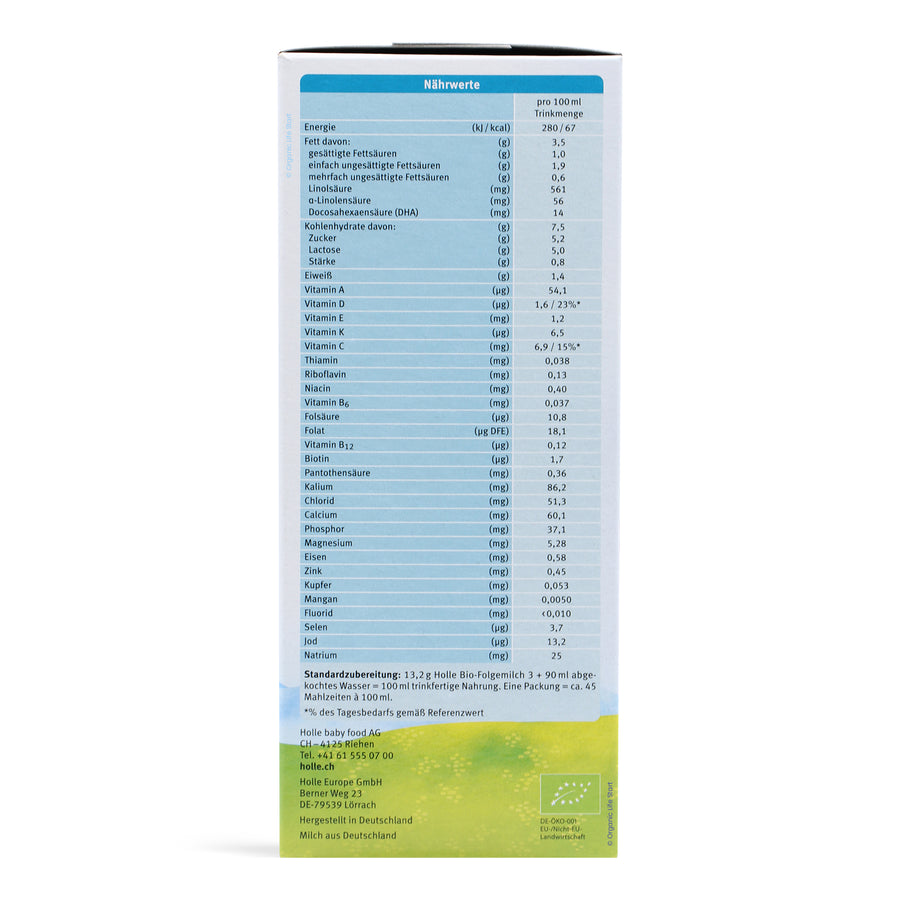
Holle Stage 3 Organic Nutritional Facts
(Per 100ml or 3.38 oz/3 oz prepared)
- Energy 67 kcal
- Total Fat 3.5 g
-
- Saturates 1 g
- Monounsaturates 1.9 g
- Polyunsaturates 0.6 g
- Linoleic Acid (Omega 6) 561 mg
- Linolenic Acid (Omega 3) 56 mg
- DHA 14 mg
- Total Carbs 7.5 g
-
- Sugars 5.2 g
- Lactose 5 g
- Starch 0.8 g
- Protein 1.4 g
- Calcium 60.1 mg
- Iron 0.58 mg
- Phosphorus 37.1 mg
- Magnesium 5.28 mg
- Chloride 51.3 mg
- Zinc 0.45 mg
- Copper 0.053 mg
- Iodine 13.2 mcg
- Manganese 0.0050 mg
- Selenium 3.7 mcg
- Fluoride < 0.010 mg
- Vitamin C 6.9 mg
- Vitamin A 54.1 mcg
- Vitamin D 1.6 mcg
- Vitamin E 1.2 mg
- Vitamin B1 0.038 mg
- Vitamin B2 0.13 mg
- Vitamin B6 0.037 mg
- Vitamin B12 0.12 mcg
- Folic Acid 10.8 mcg
- Folate 18.1 mcg DFE
- Pantothenic Acid 0.36 mg
- Potassium 86.2 mg
- Vitamin K 6.5 mcg
- Biotin 1.7 mcg
- Niacin 0.40 mg
- Sodium 25 mg
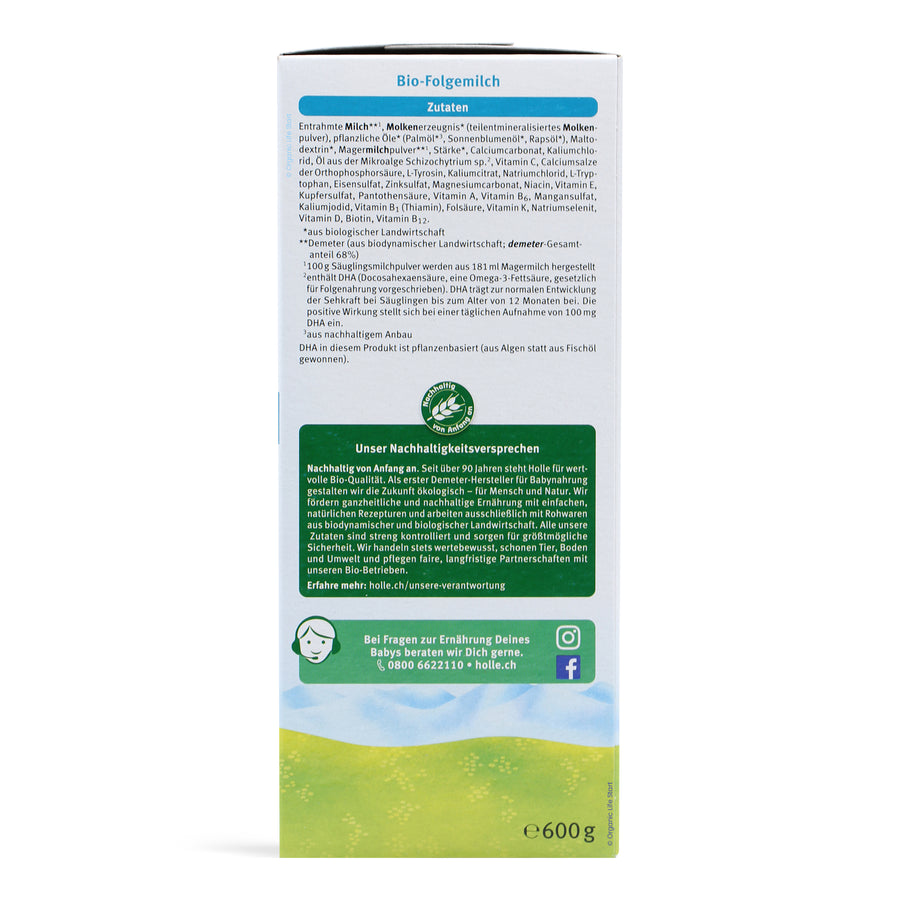
Holle Stage 3 Organic Ingredients
Organic Skimmed Milk, Organic Whey Products (Partially Demineralized Whey Powder), Organic Vegetable Oils (Organic Palm Oil, Organic Sunflower Oil, Organic Rapeseed Oil), Organic Maltodextrin, Organic Whey Powder, Starch, Calcium Carbonate, Calcium Chloride, Oil from the Microalgae Schizochytrium sp.2, Vitamin C, Calcium Salts of Orthophosphoric Acid, L-Tyrosine, Potassium Citrate, Sodium Chloride, L-Tryptophan, Ferrous Sulfate, Zinc Sulfate, Magnesium Carbonate, Niacin, Vitamin E, Copper Sulfate, Pantothenic Acid, Vitamin A, Vitamin B6, Manganese Sulfate, Potassium Iodide, Vitamin B1, Folic Acid, Vitamin K, Sodium Selenite, Vitamin D, Biotin, Vitamin B12.
Holle Bio Stage 3 Formula Allergens = Contains milk, milk products.
Want to know more about Holle ingredients? Check out our Holle Ingredients Tool
Human breast milk contains all of the essential ingredients your baby needs for growth and development. Before starting any supplemental feeding using baby formula, consult with your pediatrician to discuss the best options for your little one.
Please note that this product is manufactured to meet European standards for iron and other nutritional values. These requirements may differ by country, as there is no global standard for such nutritional values. Customers in Australia, Canada, the US, and China may require additional supplements to meet local nutritional guidance.
Holle Bio Stage 3 Formula Instructions
Begin by washing your hands and sterilizing your equipment and workspace. In order to kill off any residual bacteria that may be in your water, boil 1 liter of water and leave it to cool for up to 30 minutes.
Read the feeding chart relevant to your specific formula. Depending on your baby's age, add the corresponding water and formula ratios. Use the formula scoop provided inside of your box so as to ensure accurate measurements.
Close the bottle with a sterilized cap and shake vigorously until all formula powder has been dissolved and no lumps remain. We recommend placing a nipple cap over the bottle top so as to avoid touching it with your hands.
Baby formula is ready for feeding when it reaches body temperature (~98°F). You may cool the formula in the refrigerator in order to reach this desired temperature, and you can test the formula on your forearm to make sure it isn't too hot. Use the formula immediately after preparation.
Holle Bio Stage 3 Formula Baby Brezza Settings
Please note that Baby Brezza may change their suggested settings at any time. Organic Life Start is not affiliated with Baby Brezza and these settings are for your convenience based on publicly available information. We bear no responsibility for the accuracy of these settings should Baby Brezza change them. Always ask your pediatrician for feeding guidance specific to your baby.
- Each baby formula uses different mixing proportions. Only use the scoop that is included in your formula.
- Only add water and scoops at the ratios intended by the manufacturer. Do not supplement the milk feeds with any additional ingredients.
- Do not prepare feeds in advance. In order to maintain maximum nutritional value, use the feeds immediately and dispose of any leftovers feed.
- Once prepared, feed should be used within 1 hour. Prepared formula should not be refrigerated, stored, or reheated in any way, as this could increase the risk of bacterial contamination from sources external to the formula, and storage may cause prepared formula to separate.
- Once opened, formula should be used within 21 days. Any unopened formula should not be used after the expiration date printed by the manufacturer on the box.
Product Description
Holle Bio Stage 3 — Organic Toddler Formula for Growing Children
As your child grows more active and explores solid foods, Holle Bio Stage 3 offers the perfect nutritional bridge for children 10 months and older. This Demeter-certified biodynamic follow-on formula is made from the purest organic cow's milk. It provides everything your toddler needs for healthy development, along with a varied diet.
What makes Holle truly special is its uncompromising quality. Carrying the highest Demeter standard, it comes from the farms that nurture soil, plants, and animals in harmony. It's 100% GMO-free with no artificial additives, soy, refined sugars, corn syrup, or synthetic preservatives. It's all about the clean, natural ingredients parents trust.
Holle Stage 3 delivers balanced nutrition tailored for growing toddlers. It includes calcium and vitamin D for strong bones and teeth, iron for healthy blood, and DHA (omega-3) for brain and vision development. The gentle whey protein, organic vegetable oils, and organic maltodextrin ensure easy digestion and sustained energy.
Whether complementing breast milk or serving as the main milk drink, Holle Bio Stage 3, or Holle Bio Folgemilch 3, supports your child's growth, immunity, and cognitive milestones. It offers the purest European organic quality. It's the trusted next step for health-conscious families seeking the very best.
Key Nutritional Benefits of Holle Stage 3
The growth phase from 10 months onward is rapid, and toddlers need the specific nutrients to fuel their development. Holle Bio Stage 3 offers a carefully balanced mix of vitamins, minerals, and macronutrients. Each component plays a vital role in supporting your toddler's ongoing health:
- DHA (Docosahexaenoic Acid). This omega-3 fatty acid is added to support mental development and good vision. DHA is a primary structural component of the brain and retina.
- Calcium and Vitamin D. Calcium is essential for building and maintaining strong, healthy bones and teeth. Vitamin D is paired with it because it helps the body absorb calcium effectively.
- Iron. This mineral is crucial for healthy blood formation and helps transport oxygen throughout the body. Getting enough iron is important for energy and preventing anemia.
- Organic Maltodextrin. This simple carbohydrate is derived from organic sources. It provides easily digestible energy, making the formula satisfying without adding refined sugar.
- Whey and Casein Proteins. These are the building blocks for growth. The ratio in Holle Bio formula Stage 3 is gentle and highly digestible for a toddler's stomach.
The quality of the ingredients is a key benefit. All the milk used in Holle Bio Stage 3 comes from the biodynamic farms in Germany. These farms adhere to the strict Demeter standards, ensuring a clean, pure source of nutrition for your child. The clean ingredient list means you're giving your toddler the food free from unnecessary chemicals and additives.
Why Holle Bio Stage 3 Is Ideal for Toddlers
Toddlers 10 months and older are typically transitioning to a diverse diet of solid foods. The Holle Bio organic formula at this age serves as a nutritional safety net, ensuring they continue to receive the key vitamins and minerals. Holle Stage 3 is specifically designed for this phase. It complements the nutrients gained from purees, mashed foods, and table meals, helping fill any potential gaps in their diet.
One of the great features of this formula is its allergen-conscious formulation. The ingredients are certified gluten-free, making it a suitable choice for babies with gluten sensitivities. Additionally, the recipe contains no soy, a common allergen, so its exclusion is a major benefit for many families.
The formula is gentle on the digestive system, helping ensure smooth growth and development during this busy time. Choosing Holle Bio Stage 3 means choosing a product tailored to the needs of a growing older baby or young toddler.
Preparing Holle Stage 3 Safely and Accurately
Proper preparation is vital for your baby's health and safety. Always follow the instructions printed on the Holle Stage 3 formula box:
- Step 1: Hygiene First. Wash your hands thoroughly before preparing the formula. Sterilize the bottle, nipple, and ring by boiling them or using a sterilizer.
- Step 2: Boil the Water. Bring the water to a boil and let it cool to about 50°C (122°F). Using water that's too hot can damage the nutrients.
- Step 3: Measuring. Add the required amount of water into the bottle. Use the scoop provided in the box and level off the powder using a clean knife or the built-in leveler. A typical ratio is one scoop of powder per 30 ml (1 oz) of water.
- Step 4: Mixing and Cooling. Close the bottle and shake well until the powder is completely dissolved. Cool the formula quickly to the drinking temperature (around 37°C or 98.6°F) by holding the bottle under cold running water. Always check the temperature on your wrist before feeding.
- Step 5: Feeding Amounts. The box guidance provides the recommended daily amounts based on age. However, always consult with your pediatrician for advice on the exact water ratios, scoop size, and daily feeding amounts. Never add extra Holle Bio formula scoops of powder, as this can be dangerous for your baby.
Remember to discard any unused formula within one hour after preparation. Never reheat or reuse the leftover formula.
Storage, Expiration, and Packaging Information
It's important to understand how to store and check the expiration date on your formula. Holle uses the European date format: Day/Month/Year (DD/MM/YYYY). For example, a date of 15/06/2026 means the formula expires on June 15, 2026.
The boxes of Holle Stage 3 formula are shelf-stable and are usually good for at least six months from when you receive them. Always check the stamped expiration date before using the formula.
Once you open a box, use the powder within 2 to 3 weeks. Store the opened box in a cool, dry place. Avoid keeping it in the refrigerator or near the heat sources. Always close the internal bag and the cardboard box properly after each use to keep the powder fresh.
Please note that the packaging styles for Holle formula Stage 3 can sometimes vary slightly due to design updates or changes in batch production. Regardless of minor packaging changes, always read and follow the specific instructions on your box to ensure safe and correct preparation.
Calculating How Much Holle Stage 3 Your Toddler Needs
Estimating the number of Holle Bio Stage 3 boxes you need each month can help you manage your supply. This calculation depends on a few factors, including your toddler's age, how much they drink per feeding, and how much they rely on the formula:
- Age: An older toddler (over 12 months) might drink less formula than a 10-month-old because they're eating more solid food.
- Feed Quantity: Check the box for the recommended number of feedings per day and the quantity per feeding. For example, a 10-month-old might drink four to five bottles of 180-200 ml (6-7 oz) per day.
- Supplementation: If your child is still breastfed or eating a large amount of solids, they'll need less formula. If they're relying more on the formula, you'll need more boxes.
A typical 600g box of Holle Bio Stage 3 makes about 30 to 35 standard-sized bottles of around 200 ml (7 oz) each. If your toddler drinks four 200 ml bottles a day, one box will last approximately eight to nine days. This means you'd need about three to four boxes per month. However, always adjust this estimate based on your child's individual needs.
Why Parents Trust Holle Bio Stage 3
Holle has a long and respected history in infant nutrition. The company has been committed to making high-quality food since 1933. This long-standing reputation gives parents confidence in their products.
One of the main reasons for this trust is the Demeter certification, one of the strictest organic certifications available worldwide. It ensures:
- Biodynamic Farming. This system treats the farm as a living organism, promoting soil health and biodiversity.
- Animal Welfare. The cows are raised in a natural, respectful environment. They're not dehorned and have ample time to graze in open pastures.
- Nutrient Quality. The milk produced under these conditions is known for its high quality and purity.
This commitment extends to sustainability. Holle works to minimize its environmental impact. By choosing the Holle organic products, parents support a sustainable and ethical approach to agriculture. This aligns with a growing desire to provide both premium nutrition and support responsible production.
The combination of historical reliability, strict organic standards, and high nutrient quality makes Holle formula Stage 3 a trusted choice for parents worldwide.
Product Guides Featuring Holle Stage 3 Organic
Organic Life Start answers
Holle Stage 3 Organic Frequently Asked Questions
FAQ: Holle Bio Stage 3
Holle Bio Stage 3 is designed for babies 10 months and older. It complements a balanced diet of solid foods and milk.
Yes, you can transition from Holle Bio Stage 2 to Stage 3 once your baby reaches 10 months to meet their growing nutritional needs. It’s always best to consult your pediatrician before making any changes to your baby’s formula.
Yes, Holle Bio Stage 3 is gluten-free, making it suitable for babies with gluten sensitivities.
No, Holle Bio Stage 3 is meant to complement solid foods and should not be the sole source of nutrition for babies over 10 months. It's best to consult your pediatrician for guidance on how to incorporate this formula into your baby's weaning plan.
Most babies tolerate Holle Bio Stage 3 well, but any formula change can affect digestion. If your baby experiences constipation, it's advisable to consult your pediatrician to evaluate their diet and formula choice.
Yes, babies can typically transition from Holle Stage 2 to Stage 3 once they reach 10 months of age. However, it's always a good idea to consult your doctor before making any changes.
Store the unopened box in a cool, dark, and dry place, like a pantry or cupboard. Once opened, close the package properly after each use and use the contents within two to three weeks for the best freshness and quality.
Trustpilot · Excellent 4.9 · Over 3,985 5-star reviews
Holle Stage 3 Organic Reviews
Over 3,985 5-star reviews
I switched to this formula to help my daughter with her colic and general constipation issues. She is doing so much better now. Very happy to have found something that works for her.
Ordering from Organic Life Start was so easy. Out of all the places I looked for better pricing and options, organic life start was the best. I loved how I also received my order within two business days. I will definitely be placing an order with them again
I had a great experience. Fast shipping and got my formulas on time
I enjoy this brand of formula. It is easy on my daughter's stomach and is something I don't have to worry about ingredient-wise. The discounted price and fast shipping is great! -Marisa J.
Video Reviews

 Georgie S.
 Megi K.
Holle Bio Stage 3 Formula is made by Holle in Switzerland. Each 600g box sold by Organic Life Start has a guaranteed shelf life of at least 6 months. This box of Holle Bio comes in 5 age-specific stages, Holle Bio Stage 3 Formula specifically offers nutrition for babies aged 10+ months. If your baby is 18 months or older, consider transitioning to Holle Bio Stage 4. In terms of allergens, this formula contains milk, milk products.
Each box of Holle Bio Stage 3 Formula includes a pre-measured 4.4g scoop. You can make Holle Bio Stage 3 Formula in a Baby Brezza using the 9 setting for Baby Brezza Pro machines, or 6 setting with Baby Brezza Advanced machines.
This formula is regulated to comply with by EU EFSA standards. Holle Stage 3 Organic is manufactured to exceed EU requirements for infant nutrition outlined by the European Food Safety Authority.
Shop Organic Baby Formulas
Explore all formulas