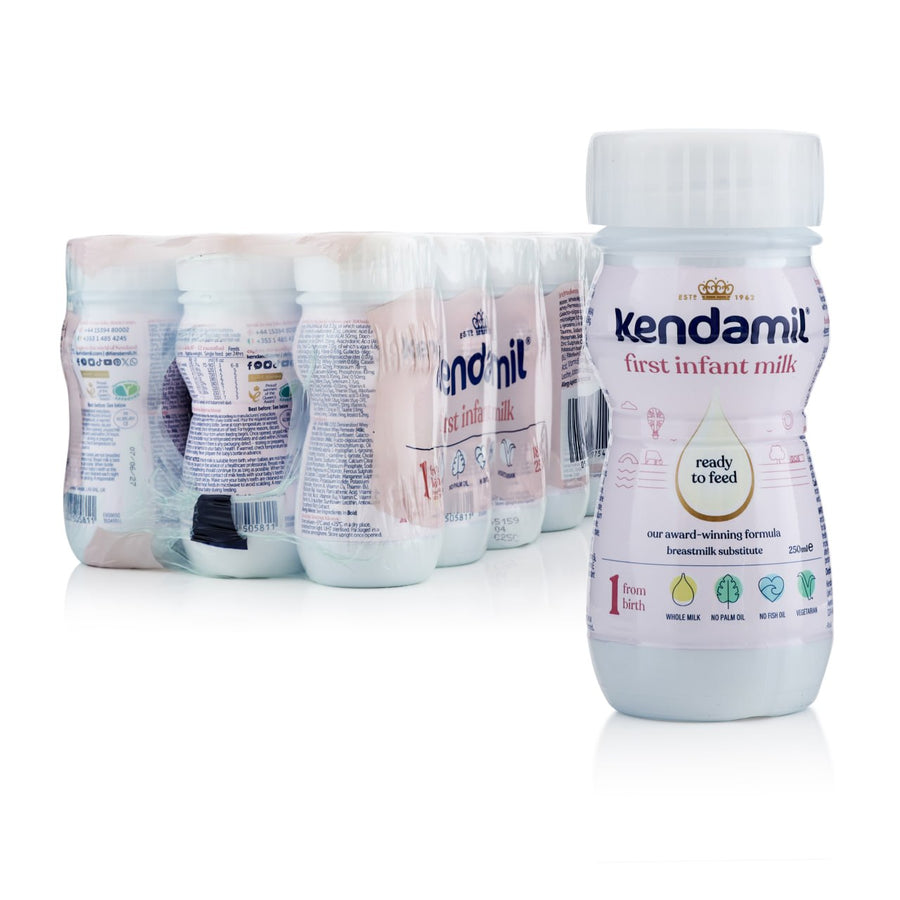
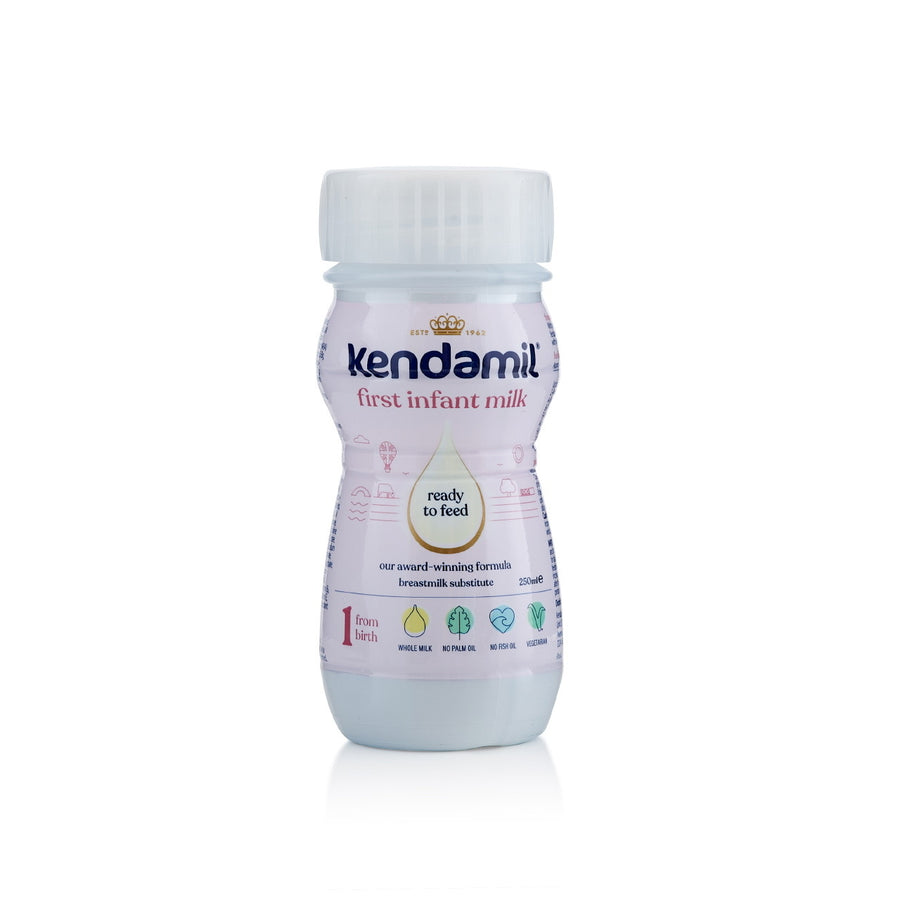
Kendamil Classic Ready to Feed Stage 1
0-6 Months • 250ml bottle
All offers and discounts are valid exclusively for Kendamil formula.
One-Time Purchase: Enjoy free express air shipping on all one-time purchases of $190 or more.
All subscription plans can be edited, paused, or canceled at any time before your next order is processed. Please note that free express air shipping is a benefit of active subscriptions only — if a plan is paused or canceled, orders return to the standard $190 free shipping minimum shown above.
The Organic Life Start Difference
We want to empower all parents to make an informed decision about where they buy. Here's why over 70,000 parents have chosen to shop with us.
| Feature | Organic Life Start | Competitors |
|---|---|---|
| Typical Courier Pickup Time | <3 hours | ~48 hours |
| Average Shipping Time | 2-4 business days | 4-9 business days |
| Order Processing | 7 days/week | 5 days/week |
| Delivery Guarantee | Marked as "delivered" or reship free | None |
| Customer Service Response | <17 minutes average | ~36 hours average |
| Customer Service Staff | 100% are moms | 100% generic |
| Kendamil Classic Ready to Feed Stage 1 Authenticity | Newest stock from Kendamil | Unknown product origins |
Over 4,048 5-star reviews
Amazing experience I was very pleased how quickly I got my order
Amazing experience I was very pleased how quickly I got my order
Great Deal!
Received my order quite quickly and was able to stack a discount on top of the buy 3 get 4. I got a great deal I couldn’t find else where!
It is very easy to order from this company. I love the fact that they have a lot of different selections. My order arrived very fast
It is very easy to order from this company. I love the fact that they have a lot of different selections. My order arrived very fast
Quick shipping, good product, legit website, got kendamil comfort because not sold in stores here and regular kendamil was out of stock
Quick shipping, good product, legit website, got kendamil comfort because not sold in stores here and regular kendamil was out of stock
Delivery was quick
Delivery was quick
Love it! Original EU formula and excelente customer service 🥰Fedex made a issue with my delivery so customer service of Organic life start helped a lot with fast issues solving❤️
Love it! Original EU formula and excelente customer service 🥰Fedex made a issue with my delivery so customer service of Organic life start helped a lot with fast issues solving❤️
Easy to order and arrived quickly; no issues!
Easy to order and arrived quickly; no issues!
Excellent service and great quality product!
Excellent service and great quality product!
Great company and customer service! We ordered our son’s HIPP ditch infant formula from them and the product was perfect and shipping was very quick! -Kaitlyn Peden
Great company and customer service! We ordered our son’s HIPP ditch infant formula from them and the product was perfect and shipping was very quick! -Kaitlyn Peden
Quick Responses, Kind People, and Peace of Mind
A big thank-you to Lyn, Stephanie, and Isabella! I reached out with a question about a recent order, and they got back to me quickly and were so kind and helpful. I really appreciated the care and attention they gave me. When you’re ordering formula for your baby, that kind of support means a lot. They made the whole experience easy and gave me peace of mind. Thanks again to all three of you!
Was able to get formula on time and my child really likes it! Also not damaged
Was able to get formula on time and my child really likes it! Also not damaged
Showing our 4 & 5 star reviews
Kendamil Classic Ready to Feed By Age
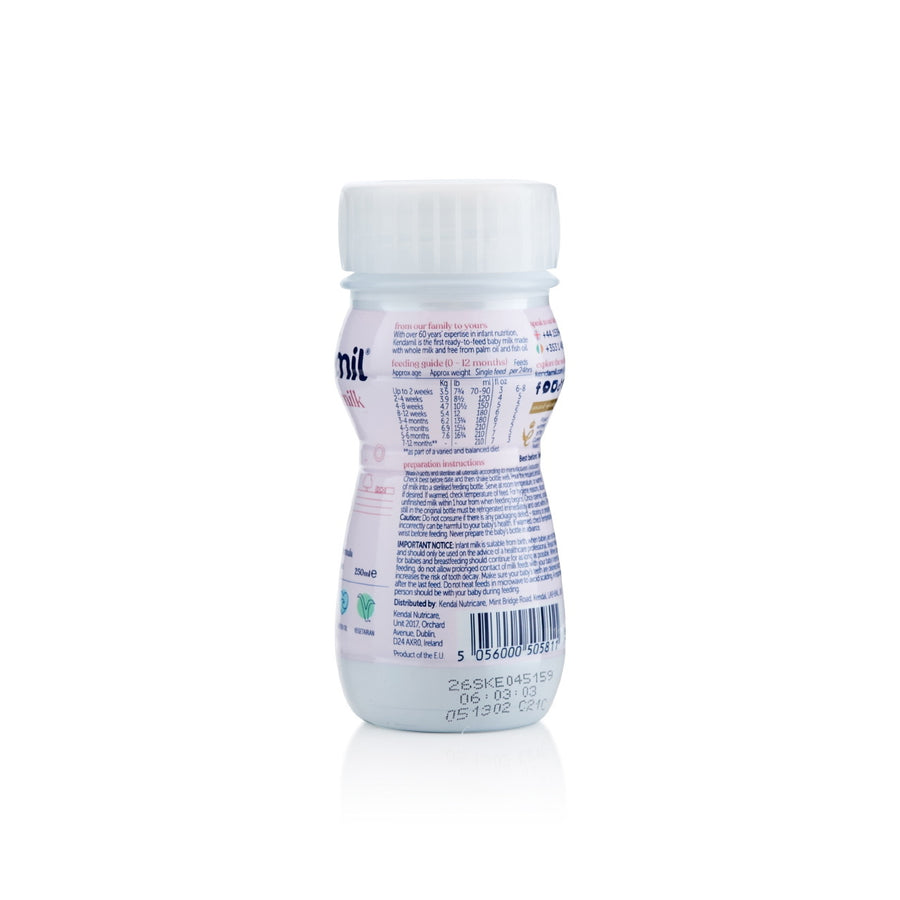
Kendamil Classic Ready to Feed Stage 1 Feeding Guide
| Age | Formula Per Feed | Meals Per Day | 250ml Bottles Per Day | Bottles Per Month |
|---|---|---|---|---|
| 1 w. | 100ml (3.4 oz) | 6 | About 2.4 | About 70 |
| 1-4 w. | 135ml (4.6 oz) | 5 | About 2.7 | About 80 |
| 1-2 m. | 135ml (4.6 oz) | 5 | About 2.7 | About 80 |
| 3 m. | 170ml (5.7 oz) | 5 | About 3.4 | About 100 |
| 4-5 m. | 200ml (6.7 oz) | 5 | About 4 | About 120 |
| 6+ m. | 235ml (7.9 oz) | 4 | About 3.8 | About 115 |
w. = weeks · m. = months
Kendamil Classic Ready to Feed Stage 1 Calculator
Baby's age in months — by default we calculate using Kendamil's recommended feed quantity for your baby's age.
Recommended at
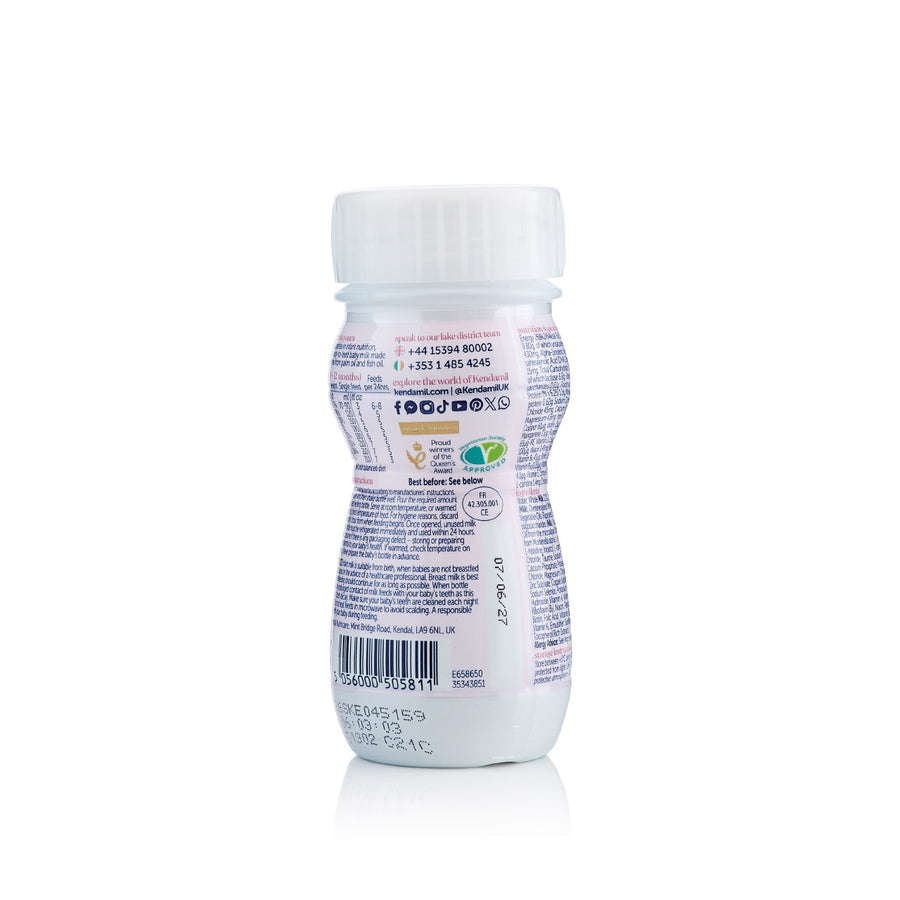
Kendamil Classic Ready to Feed Stage 1 Expiration Date: Please note that Kendamil uses the European expiration date notation, which reads DD/MM/YYYY (day/month/year). This European date format is different to the MM/DD/YYYY format more commonly found in North America.
Kendamil and our 6-month guarantee: Kendamil stock usually reaches us with many months left before its best-before date, and we always send the longest dates we have. Those dates follow what Kendamil releases to the market, though, and that varies — so Kendamil products are not covered by our 6-month expiration date guarantee.
The manufacturer may change its packaging style at any moment without notice. Always follow the instructions found on your packaging, even if they differ to the above instructions. We are not able to ship a preferred packaging style since the manufacturer decides which style they will be making in a given batch.
Perfect For
- 100% Organic Formula
- No
- Non GMO Formula
- Yes
- Sugar Free Formula
- Yes
- Corn Syrup Free Formula
- Yes
- Soy Free Formula
- Yes
- Milk Origin
- Cow
- Digestive Aid - Prebiotics
- Yes
- Digestive Aid - Probiotics
- No
- Brain Development - DHA
- Yes
- Brain Development - Omega 3
- Yes
- 100% Vegetarian Formula
- Yes
- Whey / Casein Ratio
- 52/48

Kendamil Classic Ready to Feed Stage 1 Nutritional Facts
(Per 100ml or 3.38 oz, as sold)
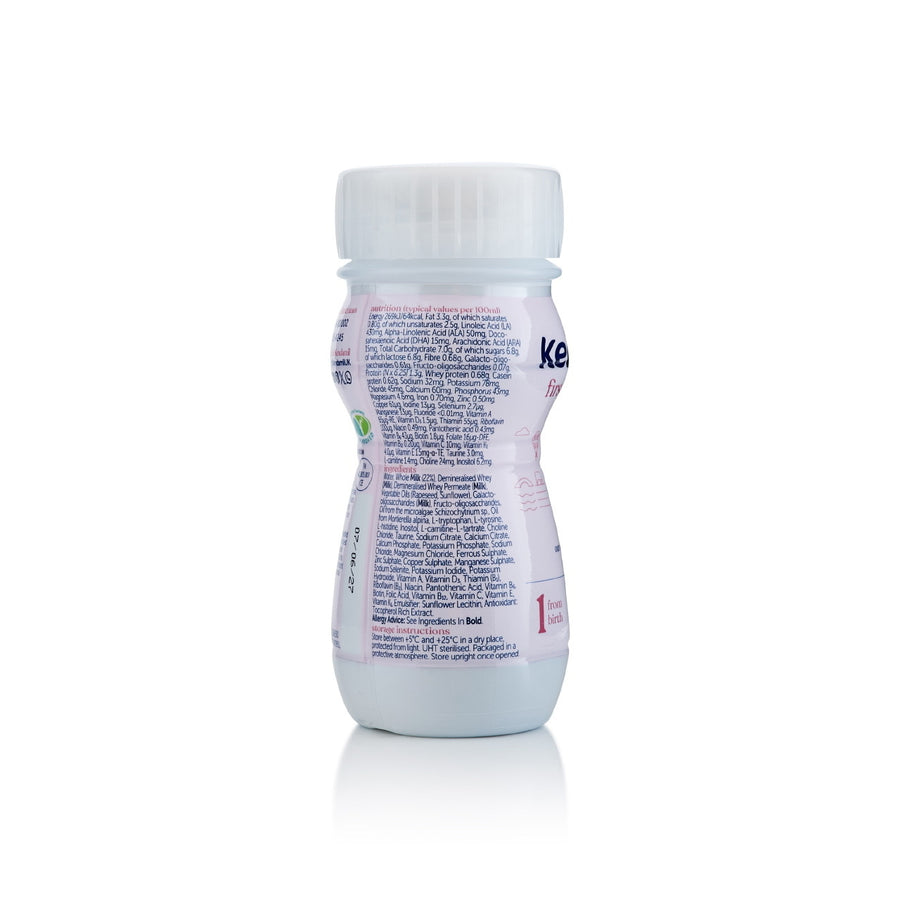
- Energy 64 kcal
- Total Fat 3.3 g
-
- Saturates 0.8 g
- Total Carbs 7 g
-
- Sugars 6.8 g
- Lactose 6.8 g
- Fiber 0.68 g
-
- Galacto-oligosaccharides (GOS) 0.61 g
- Fructo-oligosaccharides (FOS) 0.07 g
- Protein 1.3 g
-
- Whey protein 0.68 g
- Casein protein 0.62 g
- Vitamin A 65 mcg RE
- Vitamin D3 1.5 mcg
- Vitamin E 1.5 mg-α-TE
- Vitamin K1 4 mcg
- Vitamin C 10 mg
- Thiamin (B1) 55 mcg
- Riboflavin (B2) 100 mcg
- Niacin 0.49 mg
- Vitamin B6 43 mcg
- Folate (DFE) 16 mcg
- Vitamin B12 0.2 mcg
- Pantothenic Acid 0.43 mg
- Biotin 1.8 mcg
- Sodium 32 mg
- Potassium 78 mg
- Chloride 45 mg
- Calcium 60 mg
- Phosphorus 43 mg
- Magnesium 4.6 mg
- Iron 0.7 mg
- Zinc 0.5 mg
- Copper 0.061 mg
- Iodine 13 mcg
- Selenium 2.7 mcg
- Manganese 13 mcg
- Fluoride <0.01 mg
- Taurine 3 mg
- Choline 24 mg
- Inositol 6.2 mg
- L-Carnitine 1.4 mg
- α-Linolenic Acid (ALA) 50 mg
- Docosahexaenoic Acid (DHA) 15 mg
- Linoleic Acid (LA) 430 mg
- Arachidonic Acid (ARA) 15 mg
Kendamil Classic Ready to Feed Stage 1 Ingredients
Water, whole milk, demineralised whey (milk), demineralised whey permeate (milk), vegetable oils (rapeseed, sunflower), galacto-oligosaccharides (milk), fructo-oligosaccharides, docosahexaenoic acid oil (algae oil), oil from Mortierella alpina, L-tryptophan, L-tyrosine, L-histidine, inositol, L-carnitine, choline chloride, taurine, minerals (sodium citrate, calcium citrate, calcium phosphate, potassium phosphate, sodium chloride, magnesium chloride, ferrous sulphate, zinc sulphate, copper sulphate, manganese sulphate, sodium selenite, potassium iodide, potassium hydroxide), vitamins (A, D3, B1, B2, niacin, pantothenic acid, B6, biotin, folic acid, B12, C, E, K1), emulsifier: sunflower lecithin, antioxidant: tocopherol-rich extract.
Kendamil Classic Ready to Feed Stage 1 Allergens = Contains milk, milk products.
Want to know more about Kendamil ingredients? Check out our Kendamil Ingredients Tool
Human breast milk contains all of the essential ingredients your baby needs for growth and development. Before starting any supplemental feeding using baby formula, consult with your pediatrician to discuss the best options for your little one.
Please note that this product is manufactured to meet European standards for iron and other nutritional values. These requirements may differ by country, as there is no global standard for such nutritional values. Customers in Australia, Canada, the US, and China may require additional supplements to meet local nutritional guidance.
Kendamil Classic Ready to Feed Stage 1 Instructions
Wash your hands and sterilise the feeding bottle and teat as you normally would. The milk inside the bottle is already sterile; the bottle you pour it into is not.
Check the best-before date and shake the bottle well. Whole milk fat can settle while the bottle sits on the shelf, and a good shake brings it back.
Pour the amount your baby needs into the sterilised feeding bottle. Serve at room temperature, or warm it by standing the feeding bottle in warm water or a bottle warmer. Never use a microwave; it heats unevenly.
Test a drop on the inside of your wrist before feeding. Use a poured feed within two hours, or within one hour of your baby starting it, then discard what is left. Cap the opened bottle, refrigerate it and use it within 24 hours.
Kendamil Classic Ready to Feed Stage 1 Storage
- Unopened bottles are shelf-stable. Keep them somewhere cool and dry, out of direct sunlight, and go by the best-before date printed on each bottle.
- Once opened, cap the bottle, refrigerate it and use it within 24 hours.
- Do not freeze ready-to-feed milk, and do not reuse milk your baby has left in the feeding bottle.
- Ready-to-feed milk is complete as poured. Do not dilute it with water or add anything to it.
- Do not prepare feeds in advance. Pour at feeding time, and use a poured feed within 1 hour of your baby starting it.
- Any milk left in the feeding bottle after a feed must be discarded and not reused.
- Warm bottles in warm water or a bottle warmer, never in a microwave, and always test the temperature on your wrist first.
- Unopened bottles should not be used after the best-before date printed by the manufacturer. Once opened, use within 24 hours from the fridge.
Product Description
What Is Kendamil Ready to Feed Stage 1?
Kendamil Classic Ready to Feed Stage 1 is infant milk that has already been mixed, UHT sterilized and sealed at the factory. Open the cap, pour, and feed. Until that seal breaks, the milk is sterile, which is something a tin of powder can never be.
It is suitable from birth and stays appropriate for 6 months, alongside solid foods. Breast milk is still the best start where it is possible, and it is worth talking to your pediatrician or health visitor before you start or switch a formula.
In the UK, these bottles are packed in cases of 18. But we sell them by the bottle, in bundles of 6, 18, 36 and 72, so you can buy a handful for a trip or a month’s worth for the nursery.
A bit of history, because it explains the recipe. Kendamil’s first infant milk Ready to Feed launched in October 2021 and became the first ready-to-use infant milk in the UK made without palm oil or fish oil. Everything else in the liquid range came later.
If you want to compare, the tin version is here, and the certified organic liquid is here. The whole liquid line sits on the Kendamil Ready to Feed collection.
Who Is the 250ml Classic Bottle Best For?
The Kendamil Ready to Feed 250ml bottle is the biggest one Kendamil makes, and that matters more than it sounds. Since every bottle in the range costs the same here, the 250ml gives you more milk per bottle, making it the lowest cost per feed of the six.
Who actually orders it, based on what we see: parents in the first two weeks at home, before any sterilizing routine has settled. That stretch is chaos, and not measuring scoops at 3 am matters.
Kendamil Ready to Feed newborn bottles also earn their keep on travel days, in a daycare bag, or when care is split between two homes. Grandma does not need to know the scoop ratio. They are genuinely useful anywhere safe drinking water isn’t a given, including hotel rooms and long flights.
Ingredients and Nutrition per 100ml
Kendamil liquid formula stage 1 is made with whole milk, demineralized whey and whey permeate, plus rapeseed and sunflower oils. The DHA comes from algae and the ARA from Mortierella alpina, so the bottle is fully vegetarian. It also contains taurine, L-carnitine, choline, and inositol.
Milk is the only allergen on the label. The free-from list is the short version of why parents pick it: no palm oil, fish oil, soy, added sugar, or maltodextrin. The milk is Red Tractor assured, meaning the British farming standards behind it are audited, not just claimed.
| Nutrition | Amount per 100ml |
|---|---|
| Energy | 64 kcal |
| Protein (whey / casein) | 1.3g (0.68g whey, 0.62g casein) |
| Fat | 3.3g |
| Lactose | 6.8g |
| Prebiotic fiber | 0.68g (0.61g GOS + 0.07g FOS) |
| DHA / ARA | 15mg / 15mg |
| Iron / calcium | 0.70mg / 60mg |
| Vitamin D | 1.5µg |
The prebiotic fiber is high for ready-to-feed milk, and the DHA and ARA are matched exactly one-to-one, which is unusual. Most formulas run ARA below DHA. If ingredient lists are your thing, our European formula ingredient database breaks down what each of these actually does.
Is the Bottle the Same as Kendamil Classic Stage 1 Powder?
No, and this is the single most useful thing.
Kendamil Ready to Feed Stage 1 is its own liquid recipe, not the Classic tin with water stirred in. A shelf-stable liquid has to be formulated differently, so the oil blend changes, the prebiotic fiber goes up, and the powder’s nucleotides aren’t in the bottle.
In practice, most babies settled on the tin and took the bottle without blinking. But if your baby has a sensitive stomach or reacts to changes, treat the switch as a product change, not just a format change. Introduce it gradually and watch how it goes.
If you want a liquid that matches the tin exactly, that is the organic bottle instead. The Organic Ready to Feed Stage 1 is the organic tin made up, in a 200ml bottle, with nucleotides and 3'-GL included.
Here is how the powder compares with Kendamil first infant milk Ready to Feed:
| Feature | Classic Stage 1 powder | Liquid bottle Stage 1 |
|---|---|---|
| Oils | Sunflower, coconut, rapeseed | Rapeseed, sunflower |
| Prebiotic fibre | 0.27g | 0.68g |
| DHA / ARA | 16.1mg / 8mg | 15mg / 15mg |
| Nucleotides | 2.9mg | None |
| Whey : casein | About 60:40 | About 52:48 |
| Unopened shelf life | 2 years | 12 months |
How to Serve and Store the Bottles
Kendamil Classic Ready to Feed Stage 1 formula is convenient, but a few simple steps keep every bottle safe and fresh. Follow this order every time you feed.
- Wash your hands and sterilize. Wash your hands thoroughly and make sure the feeding bottle and teat are properly sterilized before you start.
- Shake the bottle. Whole milk fat settles on the shelf, so a good shake brings it back together.
- Pour into a sterilized feeding bottle. A newborn feed uses well under half of a 250ml bottle. Never feed straight from the main bottle, as saliva gets in and you have to discard the rest.
- Serve at room temperature, or warm gently. Stand the feeding bottle in warm water and test a drop on your wrist. Don’t use a microwave, because it heats unevenly and creates hot spots.
- Store opened bottles in the fridge. Cap and refrigerate immediately; use within 24 hours.
- Use poured milk quickly. Use within 2 hours of pouring, or 1 hour once your baby starts drinking, then discard.
- Store unopened bottles at room temperature. Keep in a cool, dry cupboard and check the best-before date (printed day/month/year).
For more detail, see our preparation instructions and our guide on how long the formula stays good.
How Many 250ml Bottles Will You Need?
If you feed Kendamil Classic Ready to Feed Stage 1 exclusively, the number climbs steadily:
- 1 week old: about 2.4 bottles a day, roughly 70 a month
- 1 to 2 months: about 2.7 bottles a day
- 3 months: about 3.4 a day
- 4 to 5 months: about 4 a day, roughly 120 a month
Combination feeders use a fraction of that. A 72-bottle bundle of Kendamil first infant milk Ready to Feed lasts an exclusive feeder around 3 weeks. For parents who only use bottles at night, the same bundle stretches to 2 or 3 months.
On pricing: the 6 and 18 packs cost the same per bottle, the 36 costs less, and the 72 is the cheapest. Subscribe & Save runs on the 18, 36, and 72 bundles, takes another 5% off, and ships express free, renewing every 2, 3, or 4 weeks. Skip, pause, or cancel anytime before the next order processes. Orders over $190 ship free, and you can check current times on our shipping page.
Not sure whether the bottle or the tin suits your routine? The formula quiz takes about a minute.
Product Guides Featuring Kendamil Classic Ready to Feed Stage 1
Organic Life Start answers
Kendamil Classic Ready to Feed Stage 1 Frequently Asked Questions
Kendamil Ready to Feed Stage 1 FAQ
250ml, which is 8.5 fl oz. It is the largest bottle in the liquid range, and since every bottle costs the same, it offers the lowest cost per feed.
No. Sealed bottles can be kept at room temperature in a dry cupboard. The fridge only comes into play once you break the factory seal; then you have 24 hours.
A standard bottle warmer works fine for a poured feed. A Baby Brezza does not, because it is designed to mix dry powder with water rather than dispense ready-made liquid.
Yes. The Stage 1 recipe is nutritionally complete through 12 months and pairs with a weaning diet. Some families move up to Kendamil Classic Ready to Feed Stage 2 at six months, but there is no obligation to. If you're unsure, ask your pediatrician.
Yes. The DHA comes from algae rather than fish oil, and the recipe contains no animal fats or fish by-products.
Trustpilot · Excellent 4.9 · Over 4,048 5-star reviews
Kendamil Classic Ready to Feed Stage 1 Reviews
Over 4,048 5-star reviews
I’ve had a great experience ordering my baby’s formula from Organic Life. The ordering process is easy, shipping is fast, and everything arrives well packaged. It’s really reassuring to have a reliable place to order my baby’s formula. Highly recommend!
The ordering process is easy! I entered an incorrect mailing address by accident and their customer service is incredible! Answered my email within hours of sending and corrected the mistake on their side. Making delivery within less than 24 hours possible! We will be ordering again!
Great experience! My baby formula arrived quickly and right on time. The ordering process was easy and convenient and subscription feature is a great reminder and easy to use as well . I’m very happy with the service and already on my second order! Customer service is also very helpful and quick to respond!
Organic Life Start gets 5 stars from me! I am a mom of a 6 month old, and when I was looking for a follow-on milk to support my baby's development, Organic Life Start had the product I was looking for. It shipped and arrived so quickly when I was in a pinch and running low on my baby's current formula. Additionally, I am so impressed with the products available... some of the formula isn't even available in US stores such as Target and Walmart. I highly approve of and recommend Organic Life Start to other families for their baby's needs. -Andrea A.
 Georgie S.
 Megi K.
 Hannah C.
Kendamil Classic Ready to Feed Stage 1 is made in Europe for Kendamil, whose powdered formulas come from its own factory in the UK. Each 250ml bottle sold by Organic Life Start usually has many months left before its best-before date, but the dates Kendamil releases to the market vary with availability, so Kendamil is not covered by our 6-month freshness guarantee. This bottle of Kendamil Classic Ready to Feed comes in 3 age-specific stages, Kendamil Classic Ready to Feed Stage 1 specifically offers nutrition for babies aged 0-6 months. If your baby is 6 months or older, consider transitioning to Kendamil Classic Ready to Feed Stage 2. In terms of allergens, this formula contains milk, milk products.
Each bottle of Kendamil Classic Ready to Feed Stage 1 is ready to feed: there is no powder to measure and no water to boil. Shake the bottle, pour the feed into a sterilised feeding bottle and serve it at room temperature or warmed. An opened bottle keeps for 24 hours in the fridge with the cap on; unopened bottles are shelf-stable and need no refrigeration.
This formula is regulated to comply with EU EFSA standards. Kendamil Classic Ready to Feed Stage 1 is manufactured to exceed EU requirements for infant nutrition outlined by the European Food Safety Authority.
Shop Organic Baby Formulas
Explore all formulas