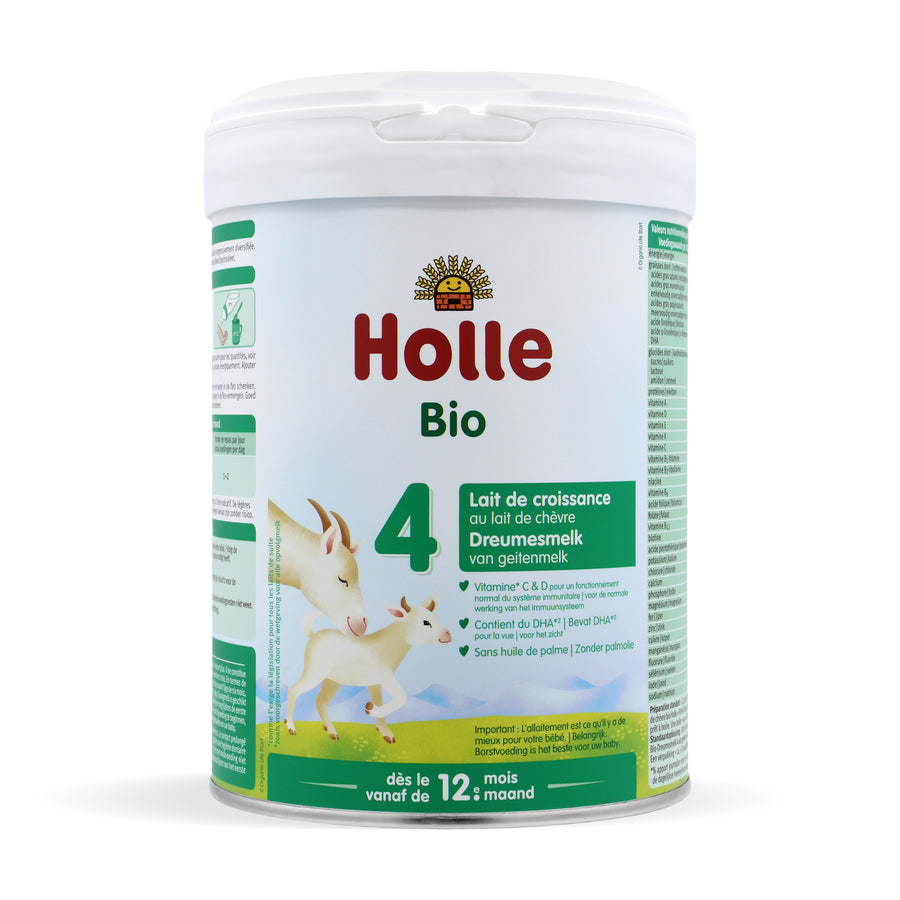
Holle Goat Dutch Formula Stage 4
12+ Months • 800g can
Holle Goat Dutch stage 4 for toddlers aged 12 months up. Each 800g can offers a gentle nutrition supplement while transitioning to solids. Soy-free, gluten-free, non-GMO.
All offers and discounts are valid exclusively for Holle formula.
One-Time Purchase: Enjoy free express air shipping on all one-time purchases of $190.00 or more.
All subscription plans can be edited, paused, or canceled at any time before your next order is processed. Please note that free express air shipping is a benefit of active subscriptions only — if a plan is paused or canceled, orders return to the standard $190.00 free shipping minimum shown above.
The Organic Life Start Difference
We want to empower all parents to make an informed decision about where they buy. Here's why over 70,000 parents have chosen to shop with us.
| Feature | Organic Life Start | Competitors |
|---|---|---|
| Typical Courier Pickup Time | <3 hours | ~48 hours |
| Average Shipping Time | 2-4 business days | 4-9 business days |
| Order Processing | 7 days/week | 5 days/week |
| Delivery Guarantee | Marked as "delivered" or reship free | None |
| Customer Service Response | <17 minutes average | ~36 hours average |
| Customer Service Staff | 100% are moms | 100% generic |
| Holle Dutch Goat Stage 4 Organic Authenticity | Newest stock from Holle | Unknown product origins |
| Typical Expiration Dates | 10-13 months | Up to 6 months |
Over 3,989 5-star reviews
It was real and easy to order
It was easy to setup, the product was real and was easy customer service
Very happy and informed customer!
Very informative site to help make the right choice of formula for my baby. We used this site for my last baby and the HIPP formula was perfect. We loved it so much that I actually bought it just in case for my baby due in October although I plan on breastfeeding. Great communication and customer service and much better options than the typical US formulas. Delivery was as expected and even a little faster. No complaints!
i love how fast and efficient orgnaic life start is, my order arrived very fast, and was extremely well packaged. I’ll be ordering again!
i love how fast and efficient orgnaic life start is, my order arrived very fast, and was extremely well packaged. I’ll be ordering again!
The product is very awesome and excellent my nephew has been using every since he is a child until now I would honestly recommend for all mom and dad out there who are interested in it because the product are bring very much special nutrients and organic best for baby who are interested in organic best excellent products and taste for all baby I would stand by the brand and honestly respect fully of with my experience of the way I has feel and been with this product every since my nephew was born and and I chose this product for him I had nothing bad to say about this product but the best thing and awesome stuff it realize amazing i have asked others people and they have complained their said the product is to expensive but what do they know about it hello they are expensive because it good and it the best kind there is and it very hard to get it.
The product is very awesome and excellent my nephew has been using every since he is a child until now I would honestly recommend for all mom and dad out there who are interested in it because the product are bring very much special nutrients and organic best for baby who are interested in organic best excellent products and taste for all baby I would stand by the brand and honestly respect fully of with my experience of the way I has feel and been with this product every since my nephew was born and and I chose this product for him I had nothing bad to say about this product but the best thing and awesome stuff it realize amazing i have asked others people and they have complained their said the product is to expensive but what do they know about it hello they are expensive because it good and it the best kind there is and it very hard to get it.
Transitioned my 9 month old from breast milk to the Hipp formula, and she's doing great on it! Had to start in slowly part breast milk,part formula to begin with, but now she takes it without a problem. I would recommend.
Transitioned my 9 month old from breast milk to the Hipp formula, and she's doing great on it! Had to start in slowly part breast milk,part formula to begin with, but now she takes it without a problem. I would recommend.
I’m so happy I decided to try HiPP Dutch Stage 1! My daughter wasn’t getting enough from breastfeeding alone, so I started supplementing with formula. Unfortunately, she developed tummy discomfort, went several days without having a bowel movement, and her stool became green. I started wondering if the formula just wasn’t agreeing with her, so I tried switching formulas several times, but nothing seemed to help. On my sister’s recommendation, I decided to order HiPP Dutch Stage 1 and give it a try. The difference was amazing! After we started using HiPP, my daughter’s bowel movements became regular again, and her stool returned to a yellow color, similar to what it was when she was exclusively breastfed. I’m very happy with how well my daughter is doing, and she seems much more comfortable and happy too. I also really appreciate the clean and simple ingredients, which gives me peace of mind as a mom. I’m so glad I gave HiPP a try and definitely don’t regret ordering four boxes right away!
I’m so happy I decided to try HiPP Dutch Stage 1! My daughter wasn’t getting enough from breastfeeding alone, so I started supplementing with formula. Unfortunately, she developed tummy discomfort, went several days without having a bowel movement, and her stool became green. I started wondering if the formula just wasn’t agreeing with her, so I tried switching formulas several times, but nothing seemed to help. On my sister’s recommendation, I decided to order HiPP Dutch Stage 1 and give it a try. The difference was amazing! After we started using HiPP, my daughter’s bowel movements became regular again, and her stool returned to a yellow color, similar to what it was when she was exclusively breastfed. I’m very happy with how well my daughter is doing, and she seems much more comfortable and happy too. I also really appreciate the clean and simple ingredients, which gives me peace of mind as a mom. I’m so glad I gave HiPP a try and definitely don’t regret ordering four boxes right away!
My baby loves this formula! It also ships fast which is great for when I forget to order until I’m on my last box!
My baby loves this formula! It also ships fast which is great for when I forget to order until I’m on my last box!
Great product!
Great product!
Only product that soothes my baby
Great product and the only product that soothes my baby and keeps him strong. Every other product hurts his stomach and gives him gas.
Fast shipping! Had this formula available when almost every other retailer was out.
Fast shipping! Had this formula available when almost every other retailer was out.
Great products, shipped fast, tariff free (covered by the seller). Couldn’t recommend enough! Melissa Kelley
Great products, shipped fast, tariff free (covered by the seller). Couldn’t recommend enough! Melissa Kelley
Showing our 4 & 5 star reviews
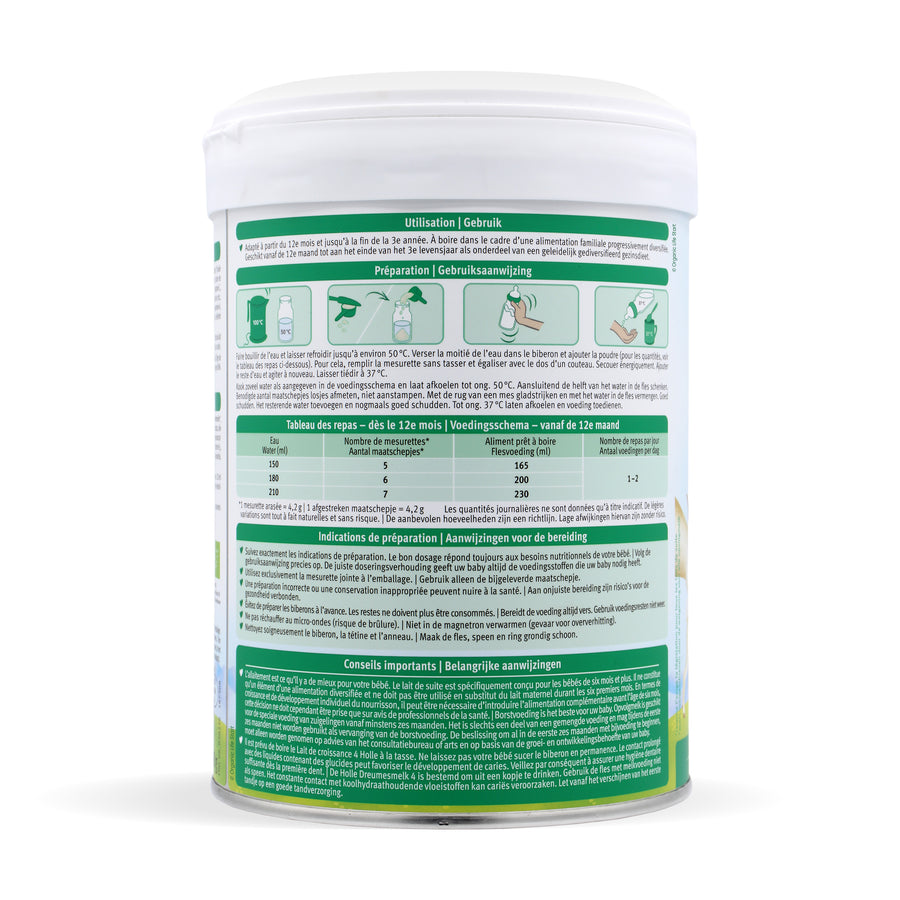
Holle Goat Stage 4 Dutch Formula Feeding Guide
| Age | Water | Scoops | Ready-Made Formula | Meals Per Day | Cans Needed |
|---|---|---|---|---|---|
| 12+ m. | 150ml (5 oz) | 5 | 165ml (5.6 oz) | 1-2 | 2 per month |
| 180ml (6 oz) | 6 | 200ml (6.8 oz) | 2.5 per month | ||
| 210ml (7.1 oz) | 7 | 230ml (7.8 oz) | 3 per month |
w. = weeks · m. = months
Most recent can style's feeding instructions:
Holle Goat Stage 4 Dutch Formula Calculator
Baby's age in months — by default we calculate using Holle's recommended feed quantity for your baby's age.
Recommended at
1 Package of Holle Goat Stage 4 Dutch Formula = about 182 scoops of formula. Holle Goat Stage 4 Dutch Formula Scoop Size = 4.4 grams of dry formula powder (0.155 ounces).
Please note that there are multiple styles of Holle Goat Dutch Stage 4 cans, and you may receive any of them.
How much Holle Dutch Goat Stage 4 Organic should you buy? The estimate for how many units of formula you'll need is based on an assumption that baby formula is the primary source of nutrition within your baby's diet, and takes into account Holle Dutch Goat Stage 4 Organic packaging and scoop sizes, as well as the Holle's recommended dosage at each age. Unless stated per month, the calculation is a total for the entire age bracket. On average, a typical toddler uses 2.5 cans of Holle Dutch Goat Stage 4 Organic per month, when fed using Holle's feeding instructions. If you supplement with breast milk or other foods, your calculation may be different. Always follow your pediatricians advice for feeding instructions that are unique to your baby.
Holle Dutch Goat Stage 4 Organic Expiration Date: Please note that Holle uses the European expiration date notation, which reads DD/MM/YYYY (day/month/year). This European date format is different to the MM/DD/YYYY format more commonly found in North America.
The manufacturer may change its packaging style at any moment without notice. Always follow the instructions found on your packaging, even if they differ to the above instructions. We are not able to ship a preferred packaging style since the manufacturer decides which style they will be making in a given batch.
An estimate from Holle's own feeding table, for planning your next order.
Perfect For
- 100% Organic Formula
- Yes
- Non GMO Formula
- Yes
- Sugar Free Formula
- Yes
- Corn Syrup Free Formula
- Yes
- Soy Free Formula
- Yes
- Milk Origin
- Goat
- Digestive Aid - Prebiotics
- No
- Digestive Aid - Probiotics
- No
- Brain Development - DHA
- Yes
- Brain Development - Omega 3
- Yes
- 100% Vegetarian Formula
- Yes

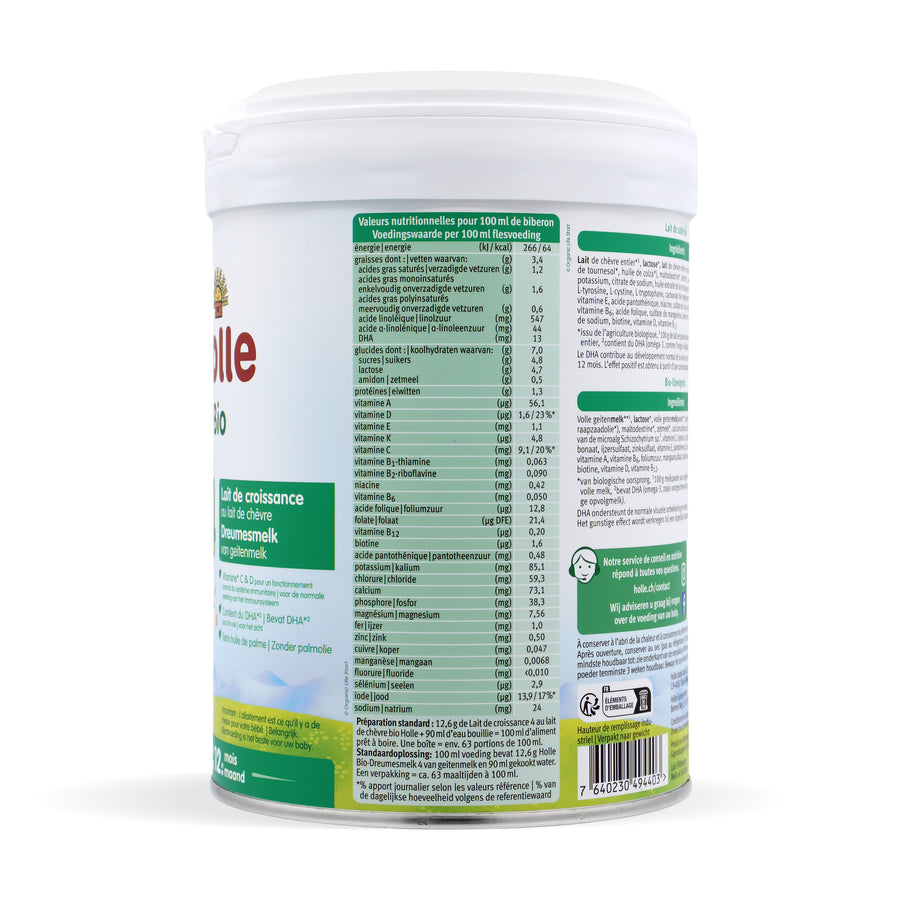
Holle Dutch Goat Stage 4 Organic Nutritional Facts
(Per 100ml or 3.38 oz/3 oz prepared)
- Energy 266/64 kJ/Kcal
- Total Fat 3.4 g
-
- Saturated fatty acids 1.2 g
- Monosaturated fatty acids 1.6 g
- Polyunsaturated fatty acids 0.6 g
- Linoleic acid (Omega 6)547 mg
- Linoleic acid (Omega 3)44 mg
- DHA 13 mg
- Total Carbs 7.0 g
-
- Sugar 4.8 g
- Lactose 4.7 g
- Starch 0.5 g
- Protein 1.3 g
- Vitamin A 56.1 mcg (RE)
- Vitamin D3 1.6 mcg
- Vitamin E 1.1 mg
- Vitamin K 4.8 mcg
- Vitamin C 9.1 mg
- Vitamin B1 0.063 mg
- Vitamin B2 0.090 mg
- Niacin 0.42 mg
- Vitamin B6 0.050 mg
- Folic Acid 12.8 mcg
- Folate 21.4 mcg (DFE)
- Vitamin B12 0.20 mcg
- Biotin 1.6 mcg
- Pantothenic Acid 0.48 mg
- Potassium 85.1 mg
- Chloride 59.3 mg
- Calcium 73.1 mg
- Phosphorous 38.3 mg
- Magnesium 7.56 mg
- Iron 1.0 mg
- Zinc 0.50 mg
- Copper 0.047 mg
- Manganese 0.0068 mg
- Flouride <0.010 mg
- Selenium 2.9 mcg
- Iodine 13.9 mcg
- Sodium 24 mg
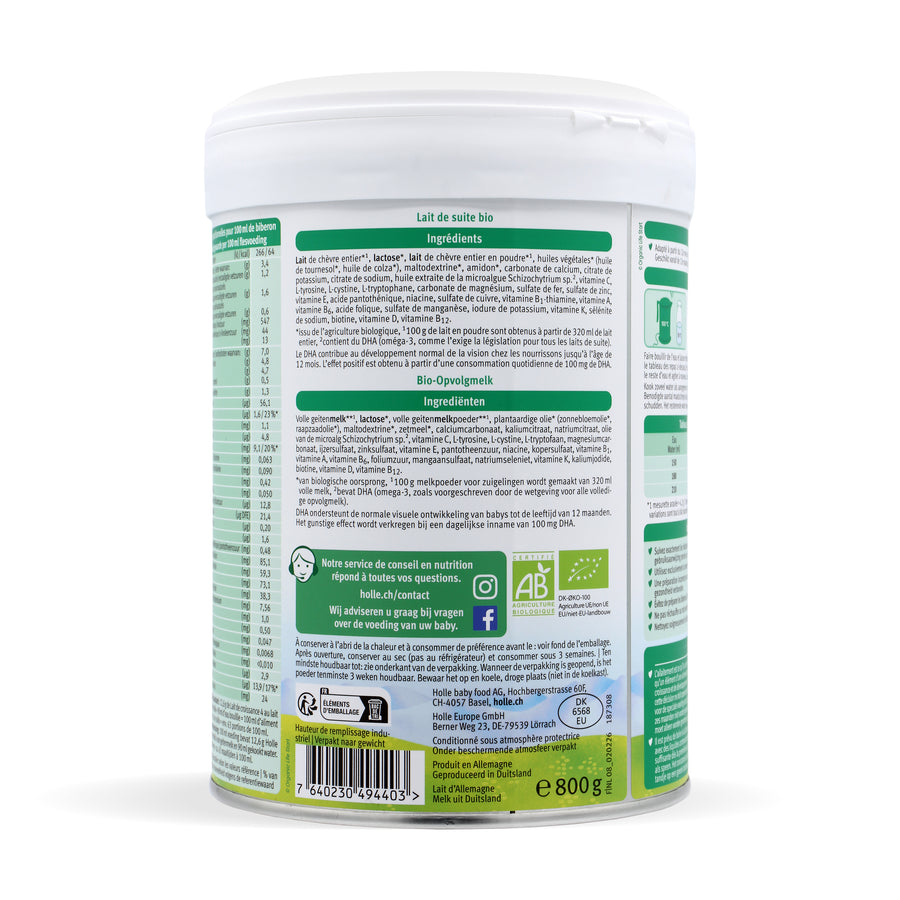
Holle Dutch Goat Stage 4 Organic Ingredients
Organic Whole Goat's Milk, Organic Lactose, Organic Whole Goat's Milk Powder, Organic Vegetable Oils (Organic Sunflower Oil, Organic Rapeseed Oil), Organic Maltodextrin, Organic Starch, Calcium Carbonate, Potassium Citrate, Sodium Citrate, Oil Extracted from the Microalgae Schizochytrium Sp., Vitamin C, L-Tyrosine, L-Cystine, L-Tryptophan, Magnesium Carbonate, Ferrous Sulfate, Zinc Sulfate, Vitamin E, Pantothenic Acid, Niacin, Copper Sulfate, Vitamin B1-Thiamine, Vitamin A, Vitamin B6, Folic Acid, Manganese Sulfate, Sodium Selenite, Vitamin K, Potassium Iodate, Biotin, Vitamin D, Vitamin B12.
Holle Goat Stage 4 Dutch Formula Allergens = Contains milk, milk products.
Want to know more about Holle ingredients? Check out our Holle Ingredients Tool
Human breast milk contains all of the essential ingredients your baby needs for growth and development. Before starting any supplemental feeding using baby formula, consult with your pediatrician to discuss the best options for your little one.
Please note that this product is manufactured to meet European standards for iron and other nutritional values. These requirements may differ by country, as there is no global standard for such nutritional values. Customers in Australia, Canada, the US, and China may require additional supplements to meet local nutritional guidance.
This product may not be suitable to be used by children who have been diagnosed with, or are suspected of having an allergy to lactose. Goat milk formulas typically contain less lactose than comparable cow's milk formulas, and while many babies with lactose sensitivity thrive on Holle Goat Stage 4 Dutch Formula, it may not be suitable if your child has severe sensitivity to lactose or is allergic to lactose. Only use this formula under the recommendation, guidance, and supervision of your child's pediatrician.
Holle Goat Stage 4 Dutch Formula Instructions
Begin by washing your hands and sterilizing your equipment and workspace. In order to kill off any residual bacteria that may be in your water, boil 1 liter of water and leave it to cool for up to 30 minutes.
Read the feeding chart relevant to your specific formula. Depending on your baby's age, add the corresponding water and formula ratios. Use the formula scoop provided inside of your box so as to ensure accurate measurements.
Close the bottle with a sterilized cap and shake vigorously until all formula powder has been dissolved and no lumps remain. We recommend placing a nipple cap over the bottle top so as to avoid touching it with your hands.
Baby formula is ready for feeding when it reaches body temperature (~98°F). You may cool the formula in the refrigerator in order to reach this desired temperature, and you can test the formula on your forearm to make sure it isn't too hot. Use the formula immediately after preparation.
Holle Goat Stage 4 Dutch Formula Baby Brezza Settings
Baby Brezza has not released any information about compatibility with Holle Goat Stage 4 Dutch Formula. Should this be updated in the future, we will add the settings here.
- Each baby formula uses different mixing proportions. Only use the scoop that is included in your formula.
- Only add water and scoops at the ratios intended by the manufacturer. Do not supplement the milk feeds with any additional ingredients.
- Do not prepare feeds in advance. In order to maintain maximum nutritional value, use the feeds immediately and dispose of any leftovers feed.
- Once prepared, feed should be used within 1 hour. Prepared formula should not be refrigerated, stored, or reheated in any way, as this could increase the risk of bacterial contamination from sources external to the formula, and storage may cause prepared formula to separate.
- Once opened, formula should be used within 21 days. Any unopened formula should not be used after the expiration date printed by the manufacturer on the box.
Product Description
The First Formula Built for Who Your Toddler Is Becoming
Most toddler formula pages open with a variation of the same pitch: gentle digestion, organic certification, happy tummies. That framing makes sense for the earlier stages, when formula is the primary source of nutrition and gentle digestion is genuinely the central concern. By twelve months, the conversation has shifted. Your toddler is eating. They are busy. They fall down, get back up, and immediately attempt something more ambitious. The question at this stage is not whether a formula is gentle enough — it is whether it is doing something specific and meaningful for a child who no longer needs formula to survive, but may still benefit from what a well-formulated one can deliver.
Holle Goat Dutch Stage 4 is formulated for exactly this period. It is not a continuation of infant nutrition logic applied to an older child — it is a reformulation built around what actually changes at twelve months and beyond, particularly around iron, where the risk of deficiency increases as formula consumption drops and dietary iron intake becomes more variable. The formula delivers 1.0 mg of iron per 100ml of prepared feed — a near-doubling of the 0.58 mg found in Stage 3 — alongside 9.1 mg of vitamin C per 100ml, which the body uses to convert dietary iron into a form it can absorb. These two nutrients are designed to work together, not just exist alongside each other.
This Is the Dutch Version — and That Distinction Matters
There are multiple Holle goat milk Stage 4 products. This is the Dutch version: produced in the Netherlands, packaged in the brand's 800g tin rather than the 400g cardboard box used for the German line, and formulated to the Dutch recipe that has underpinned Stages 1 through 3 of this line. Parents who have used Holle Goat Dutch from the beginning will recognise the tin, the scoop size, and the preparation method — Stage 4 fits directly into the routine they have already established.
The Dutch recipe differs from the German in meaningful ways. Whole organic goat's milk appears as the first ingredient — not powder, not concentrate — which means the fat profile your toddler receives reflects the natural distribution of fats in goat's milk rather than a reconstituted version. The Dutch line has always used this approach across its stage range, and Stage 4 maintains it. The texture, mixability, and taste your toddler has grown familiar with from Stages 1 to 3 carry forward here without disruption.
Why Goat Milk Still Deserves Its Place in a Toddler's Diet
The default recommendation at twelve months in most Western countries is to transition to whole cow's milk. For many toddlers this is appropriate and problem-free. But for families who have chosen goat milk formula from the start — typically because their child has handled it more comfortably — switching abruptly to cow's milk introduces a protein environment the child's digestive system has not encountered. Goat milk is naturally dominant in A2 beta-casein, the protein type that forms smaller, softer curds during digestion. Cow's milk is predominantly A1 beta-casein. These proteins behave differently in the gut, and for some toddlers the difference is noticeable.
Goat milk also has a different fat structure. The fat globules are smaller and more uniformly distributed than those in cow's milk, which increases how efficiently digestive enzymes can access and break them down. At a stage when toddlers are simultaneously asking their digestive system to process a rapidly expanding range of table foods — new textures, new proteins, new fibre sources — maintaining a familiar, easily handled milk base can reduce the number of variables being introduced at once.
Two things to be clear about: Holle Goat Dutch Stage 4 is not appropriate for toddlers with diagnosed lactose intolerance — it contains lactose as a primary carbohydrate, as all goat milk formulas do. It is also not a clinical solution for confirmed cow's milk protein allergy (CMPA). While some toddlers with cow's milk sensitivity tolerate goat milk well, those with a medically confirmed CMPA diagnosis require a hydrolysed or amino acid-based formula, as cross-reactivity between goat and cow milk proteins is common. If there is any diagnostic uncertainty, a paediatrician should confirm the right approach before switching.
What Is Different About Stage 4 Nutritionally
The shift from Stage 3 to Stage 4 in the Dutch Goat line is not cosmetic. The nutritional profile is recalibrated in several areas to reflect the documented changes in toddler dietary needs after twelve months:
- Iron: 1.0 mg per 100ml (vs 0.58 mg in Stage 3). Iron deficiency is the most prevalent nutritional deficiency in toddlers globally, and the 12-to-36-month window is the peak risk period. As formula consumption drops and solid food iron intake becomes inconsistent — particularly in toddlers who are picky eaters or eating mostly plant-based foods — a formula that actively contributes iron is a meaningful part of the dietary picture.
- Vitamin C: 9.1 mg per 100ml (vs 6.9 mg in Stage 3). Non-haem iron — the type in fortified foods and most plant sources — is far better absorbed in the presence of vitamin C. The increase in vitamin C from Stage 3 to Stage 4 is not incidental; it is specifically intended to support iron absorption from both the formula itself and the meals it is consumed alongside.
- Magnesium: 7.56 mg per 100ml (vs 5.81 mg in Stage 3). Magnesium supports muscle function, energy metabolism, and enzyme activity — all of which are under increasing demand as toddlers become more physically active through their second year.
- Vitamin E: 1.1 mg per 100ml (vs 0.88 mg in Stage 3). Supports immune and cellular health as toddlers enter social environments and encounter a wider range of pathogens for the first time.
Energy density drops slightly — Stage 4 provides 266 kJ / 64 kcal per 100ml compared to Stage 3's 280 kJ / 67 kcal. This is intentional. A twelve-month-old eating a varied diet does not need the same caloric density from formula as a younger baby for whom formula was the primary food source. Stage 4 is calibrated to complement, not compete with, solid meals.
Ingredients: What Is in the Tin and Why
The Stage 4 ingredient list reflects the same commitment to simplicity that characterises the Dutch Goat line across all stages. The base is organic whole goat's milk, organic lactose, and organic whole goat's milk powder — three forms of goat milk that together establish the formula's complete protein and fat foundation. Organic sunflower oil and organic rapeseed oil provide the unsaturated fatty acids that support ongoing brain development. Organic maltodextrin and organic starch round out the carbohydrate profile, providing satiety that pairs with — rather than replaces — solid food meals.
DHA in Stage 4 comes from Schizochytrium sp. microalgae oil — the same plant-based source used throughout the Dutch Goat range. This means no fish oil, no fishy aftertaste, and no dependence on wild catch. The formula contains no palm oil, which is a structural consequence of using whole milk: whole goat's milk naturally contains the palmitic acid that palm oil is added to mimic in formulas built on skimmed milk. It is also free from corn syrup, added sugars, soy, gluten, GMOs, artificial flavors, and preservatives.
Preparing Holle Goat Dutch Stage 4
Preparation follows the same approach as the rest of the Dutch Goat range. The scoop size is 4.2g — slightly different from the 4.4g–4.5g scoop used in Stages 1 to 3, so it is worth checking the enclosed scoop rather than relying on the one from a previous stage tin.
- Boil fresh water and allow it to cool to approximately 50°C (122°F). Too hot and heat-sensitive vitamins degrade; too cool and the powder may not dissolve fully.
- Add the recommended number of level scoops. The label specifies three serving sizes: 5 scoops to 150ml water yields 165ml of prepared formula; 6 scoops to 180ml yields 200ml; 7 scoops to 210ml yields 230ml. Use only the enclosed scoop.
- Shake until fully dissolved, then allow to cool to feeding temperature (approximately 37°C / 99°F) before testing and offering. Never microwave prepared formula.
- Discard unfinished formula after each feeding. Once opened, use the contents of the tin within three weeks and store in a cool, dry place away from direct heat.
Holle recommends 1 to 2 servings per day at this stage, alongside solid food meals — not as a replacement for them. Total feeding amounts should be guided by your paediatrician based on your child's individual appetite and dietary pattern.
On Organic Certification at This Stage
Parents familiar with the earlier Dutch Goat stages will notice that Stage 4 does not carry the Demeter biodynamic seal. This is worth explaining clearly rather than leaving as an implicit question. Demeter International — the certification body that awards biodynamic status — does not extend its certification to growing-up milks formulated for children over twelve months. This is a Demeter policy, not a change in Holle's sourcing or farming standards. The goat milk in Stage 4 comes from the same Demeter-certified farms that supply Stages 1 through 3. The animals, the land management, and the ingredient quality are unchanged. What is absent is the certification category itself, which Demeter's framework simply does not apply to this product type.
Stage 4 is certified EU organic — an independently audited legal standard that governs how the milk is produced, what can and cannot be used in the farming process, and how the formula is manufactured. For the majority of parents, the practical difference between EU organic Stage 4 and Demeter-certified Stage 3 is minimal. Both reflect the same underlying farming philosophy; only the certification paperwork differs.
Product Guides Featuring Holle Dutch Goat Stage 4 Organic
- Guide to Toddler Formula
- Toddler Formula vs. Milk Comparison
- Holle Goat Dutch vs. HiPP Dutch Goat
- Formulas For Babies With Lactose Intolerance
- Formulas For Babies With Milk Sensitivity
- Goat Milk Formula vs. Cow Milk Formula Comparison
- Vegetarian Baby Formulas
- Is Formula More Filling Than Breast Milk
- Baby Formula Protein Source
- Baby Formula Without Corn Syrup or Sugar
- Gluten Free Baby Formula
Organic Life Start answers
Holle Dutch Goat Stage 4 Organic Frequently Asked Questions
Holle Goat Dutch Stage 4 is formulated for toddlers from twelve months onwards. It is designed to complement — not replace — the solid foods your toddler is beginning to eat more regularly at this stage. If your baby has been on Holle Goat Dutch Stage 3 and is approaching twelve months, Stage 4 makes a natural next step, providing higher levels of iron, vitamin C, and magnesium to match the nutritional demands of an increasingly active toddler.
Yes, many parents choose Holle Goat Dutch Stage 4 as an alternative to transitioning directly to whole cow's milk at twelve months. Goat milk is naturally rich in A2 beta-casein protein and has smaller fat globules than cow's milk, making it gentler on digestion for toddlers who have been sensitive to cow's milk proteins throughout infancy. Stage 4 also provides a more complete nutritional profile than whole milk alone, with added iron, DHA, and vitamins that plain cow's milk does not contain.
The main ingredients in Holle Goat Dutch Stage 4 are Organic Whole Goat's Milk, Organic Lactose, Organic Whole Goat's Milk Powder, Organic Sunflower Oil, Organic Rapeseed Oil, Organic Maltodextrin, Organic Starch, and Calcium Carbonate. It also contains plant-based DHA from Schizochytrium microalgae oil and a full vitamin and mineral complex. The formula contains no palm oil, no corn syrup, no added sugar, and no artificial additives.
Holle Goat Dutch Stage 4 is certified EU organic but is not Demeter biodynamic certified. Under Demeter's own regulations, toddler formulas intended for children twelve months and older are not eligible for Demeter certification — this applies to all Stage 4 formulas across every brand. Stages 1, 2, and 3 of the Dutch Goat line do carry the Demeter seal. Stage 4 remains a high-quality EU organic product produced to the same standards on Demeter-certified farms; the certification simply does not extend to this age category.
Holle Goat Dutch Stage 4 can be a gentler option for toddlers who have experienced sensitivity to cow's milk-based formulas. Goat milk is naturally A2 beta-casein dominant and has a different protein structure to standard cow's milk, which many parents find causes fewer digestive issues such as gas, bloating, and constipation. However, goat milk is not appropriate for toddlers with confirmed lactose intolerance or diagnosed cow's milk protein allergy (CMPA), as it still contains lactose and some cross-reactive proteins. Always consult your pediatrician before switching formulas for an allergy-related reason.
Trustpilot · Excellent 4.9 · Over 3,989 5-star reviews
Holle Dutch Goat Stage 4 Organic Reviews
Over 3,989 5-star reviews
It was easy to choose the formula based on the information on the website. I got the formula so fast and my baby loves it.
I was so excited to try this formula for my granddaughter, because she’s barely two months old and has already been dealing with eczema, gas, and significant stomach issues. I made a mistake when ordering and didn’t realize I selected a type that wasn’t suitable for her lactose intolerance. The company sent exactly what I ordered, so that wasn’t their mistake. But since they don’t offer refunds, I’m now trying to sell the six-pack I purchased so I can reorder the right formula. I chose this company because of their 5-star reviews and no unnecessary additives. I’m still hoping to try the correct formula soon and hopefully see a difference for my precious granddaughter.😊
It was quick and easy to order. We got order either within a week or less.A friend referred me to the website and I am so thankful for it!!!!
I just had a baby and I was having a hard time breast-feeding so I ordered goat milk formula from organic life start and I was so happy because it was shipped and I received it so quickly. Great packaging and quality formula. Very thankful I found this company!
Video Reviews

 Georgie S.
 Megi K.
Holle Goat Stage 4 Dutch Formula is made by Holle in Switzerland. Each 800g can sold by Organic Life Start has a guaranteed shelf life of at least 6 months. This can of Holle Goat Dutch comes in 4 age-specific stages, Holle Goat Stage 4 Dutch Formula specifically offers nutrition for babies aged 12+ months. This formula is intended to be used with babies up to 24 months old. In terms of allergens, this formula contains milk, milk products.
Each can of Holle Goat Stage 4 Dutch Formula includes a pre-measured 4.4g scoop.
This formula is regulated to comply with by EU EFSA standards. Holle Dutch Goat Stage 4 Organic is manufactured to exceed EU requirements for infant nutrition outlined by the European Food Safety Authority.
Shop Organic Baby Formulas
Explore all formulas